Water mist fire extinguishing systems are automatic fire extinguishing systems that, under a specified operating pressure, atomize water into fine droplets through water mist nozzles and discharge them onto the surface of protected objects or into protected enclosures to achieve fire extinguishment or fire control.
Water mist fire extinguishing systems suppress fire mainly through cooling, oxygen dilution, attenuation of radiant heat, and smoke scrubbing. These systems feature low water consumption, high fire suppression efficiency, environmental friendliness, and minimal water damage.
2. Low-, Medium-, and High-Pressure Water Mist Fire Extinguishing Systems
According to the operating pressure of the flowing medium in the distribution piping, water mist fire extinguishing systems can be classified as low-pressure, medium-pressure, and high-pressure systems.
Under NFPA 750, low-pressure systems operate at P ≤ 12.1 bar (175 psi), medium-pressure systems operate at 12.1 bar (175 psi) < P < 34.5 bar (500 psi), and high-pressure systems operate at P ≥ 34.5 bar (500 psi). By comparison, the Chinese standard defines low-pressure systems as operating at P < 1.20 MPa, medium-pressure systems at 1.20 MPa ≤ P < 3.50 MPa, and high-pressure systems at P ≥ 3.50 MPa. Overall, the classification method is basically the same, although the specific threshold values differ slightly.
Low-Pressure Water Mist Fire Extinguishing Systems
Low-pressure water mist fire extinguishing systems operate at relatively low pressure and are suitable for applications where spray intensity and atomization performance are not especially demanding.
Medium-Pressure Water Mist Fire Extinguishing Systems
Medium-pressure water mist fire extinguishing systems provide a balance between atomization performance and system economy, and are suitable for fire protection in certain industrial and civil applications.
High-Pressure Water Mist Fire Extinguishing Systems
High-pressure water mist fire extinguishing systems operate at relatively high pressure. In engineering practice, systems designed at around 100 bar (approximately 1,450 psi) are common. These systems generally provide better atomization performance and can produce finer and more uniform droplets, resulting in stronger fire extinguishing and fire control capability. They are suitable for applications where high extinguishing efficiency and reduced water damage are important.
3. Pump-Supplied Water Mist Fire Extinguishing Systems
Pump-supplied water mist fire extinguishing systems use a pump assembly to provide pressurized water supply. They mainly consist of a pump unit, section valves, piping, water mist nozzles, and related control components. These systems are capable of continuous water supply and are suitable for applications with relatively large protection areas or demanding discharge duration requirements. According to nozzle type, pump-supplied water mist fire extinguishing systems can be classified into open nozzle water mist fire extinguishing systems and automatic nozzle water mist fire extinguishing systems.
3.1 Open Nozzle Water Mist Fire Extinguishing Systems
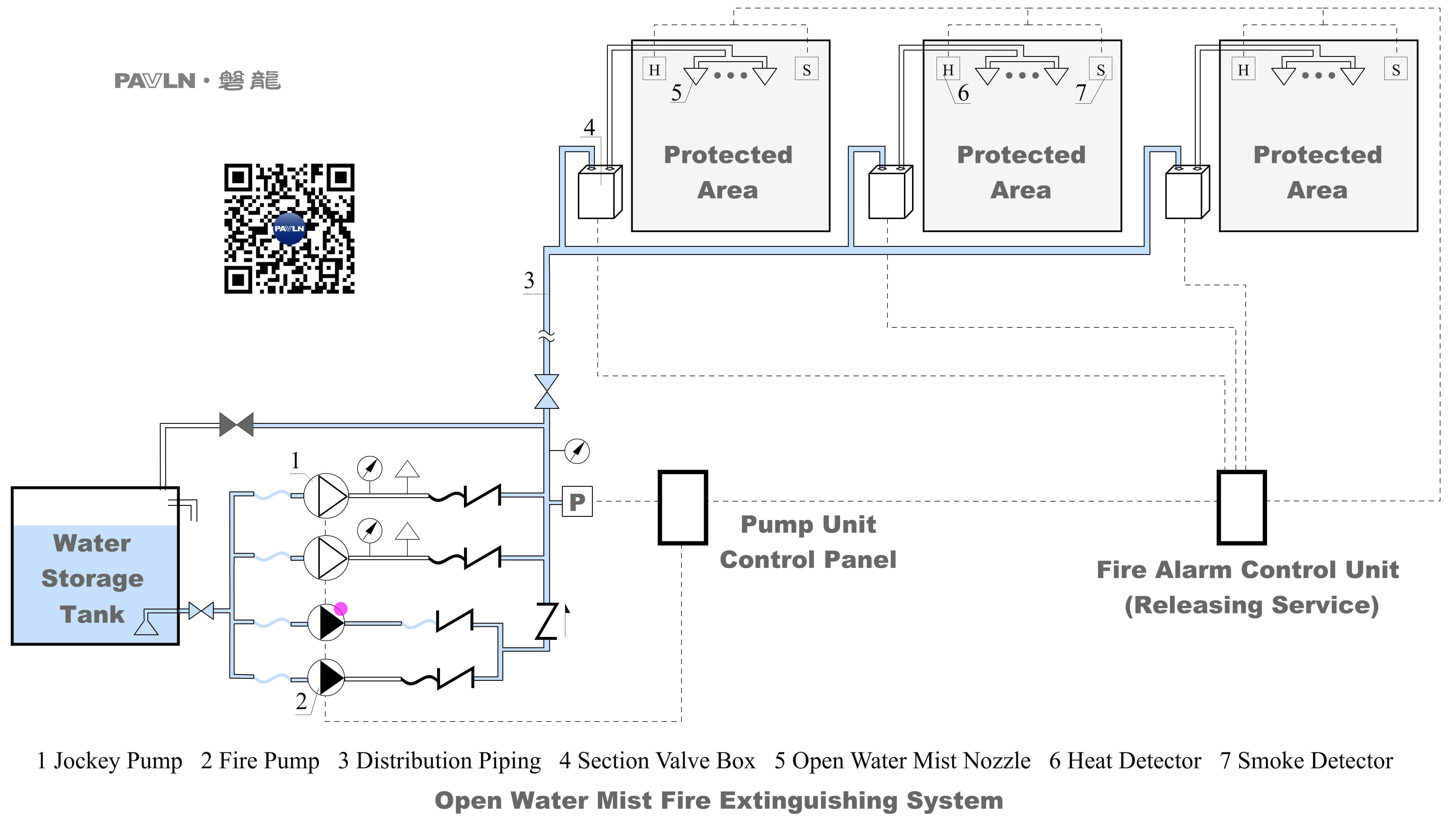
Open nozzle water mist fire extinguishing systems use open water mist nozzles. After a fire occurs, the fire alarm and control system opens the section valve and starts the water mist pump unit, supplying water to the nozzles within the protected area or around the protected object for water mist discharge [Figure 1] [Video 1]. These systems are suitable for total flooding applications and local applications.
Figure 1. Open Nozzle Water Mist Fire Extinguishing System
Video 1. Open Nozzle Water Mist Fire Extinguishing System Discharge Sequence
3.2 Automatic Nozzle Water Mist Fire Extinguishing Systems
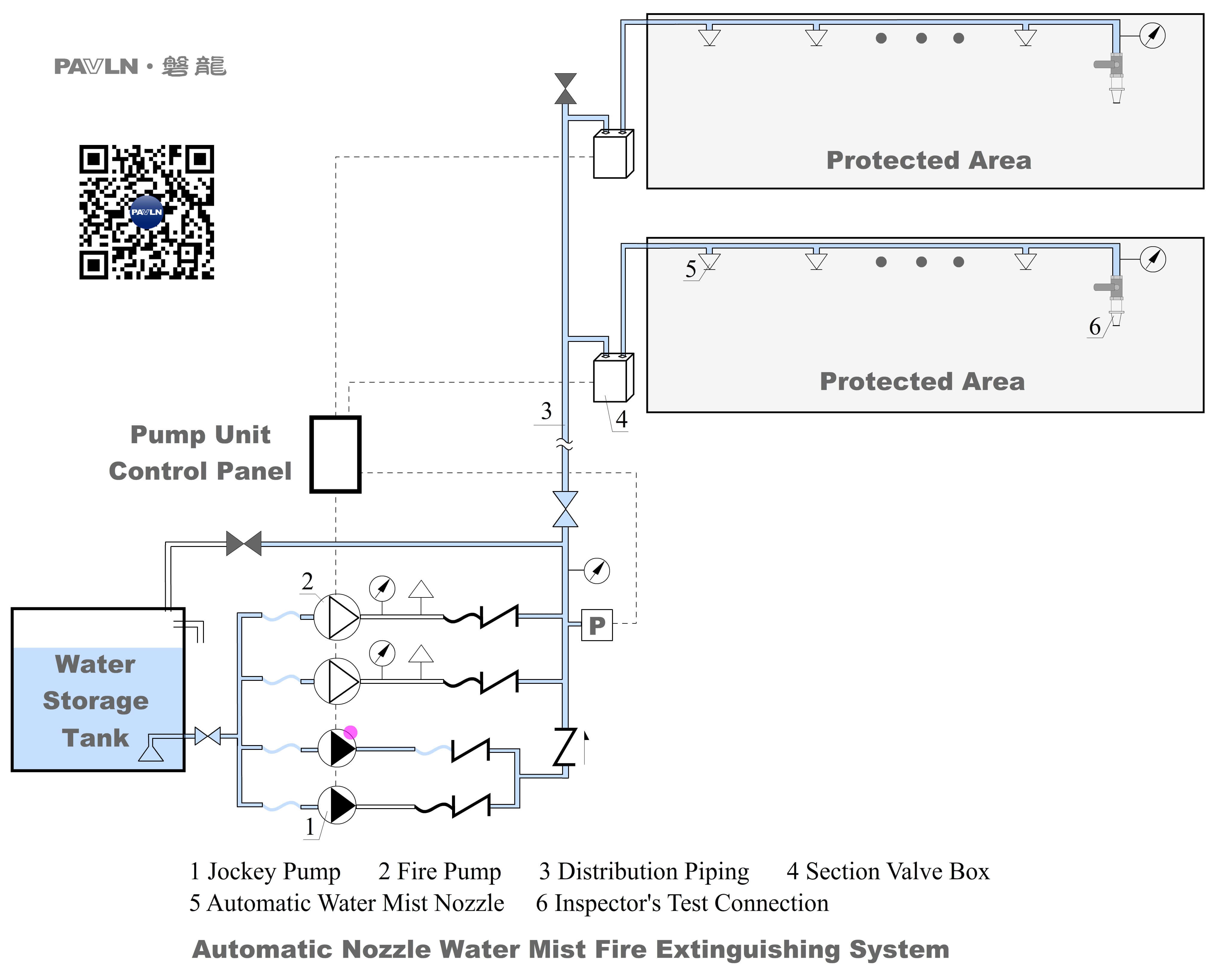
Automatic nozzle water mist fire extinguishing systems use automatic water mist nozzles. In the event of a fire, the operated nozzles begin discharging water, the flow switch sends a waterflow signal, and the water mist pump unit is started according to the preset control logic [Figure 2] [Video 2]. Depending on system design requirements, automatic nozzle water mist fire extinguishing systems may be configured as wet systems or preaction systems.
Figure 2. Automatic Nozzle Water Mist Fire Extinguishing System
Video 2. Automatic Nozzle Water Mist Fire Extinguishing System Discharge Sequence
3.3 Main Components
3.3.1 Pump Unit
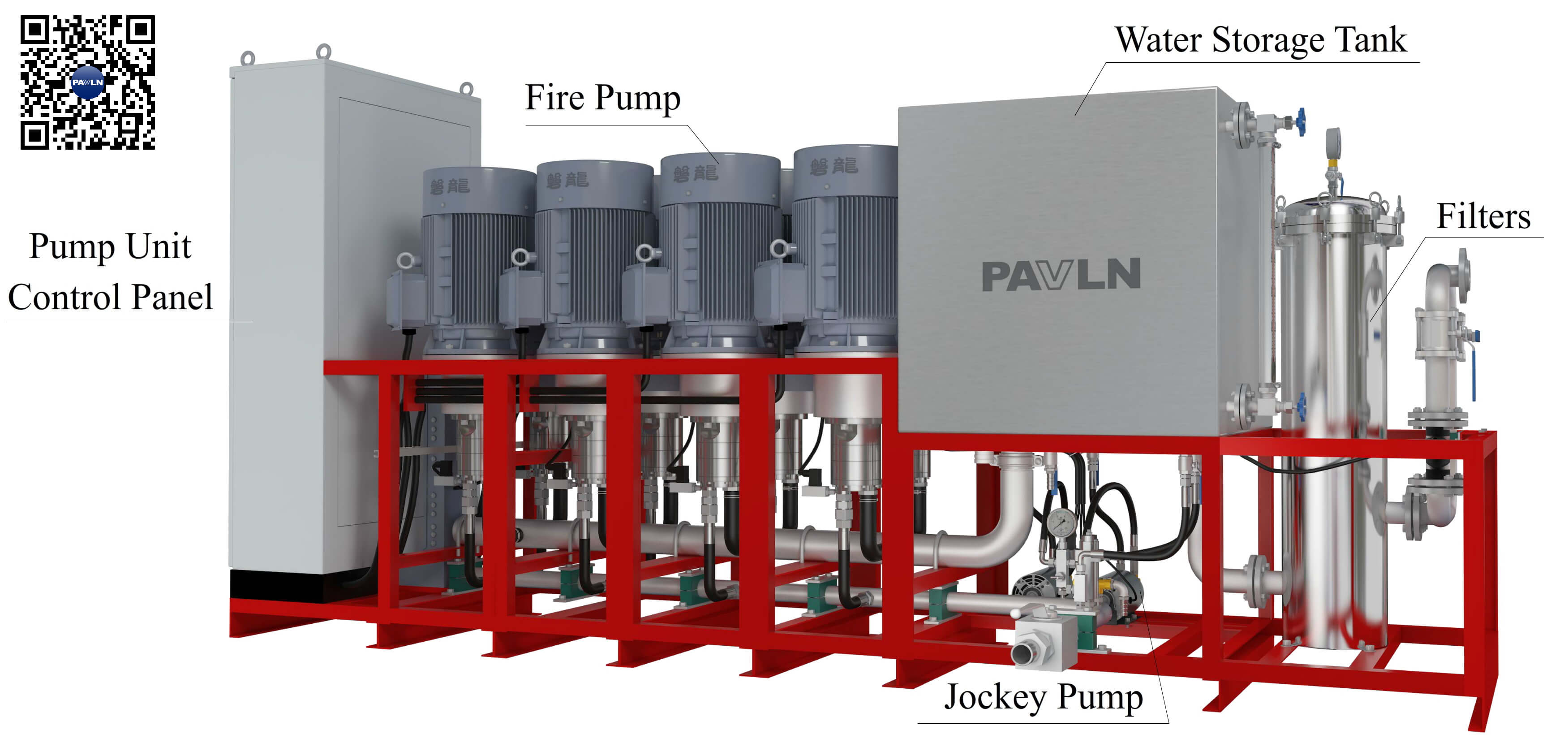
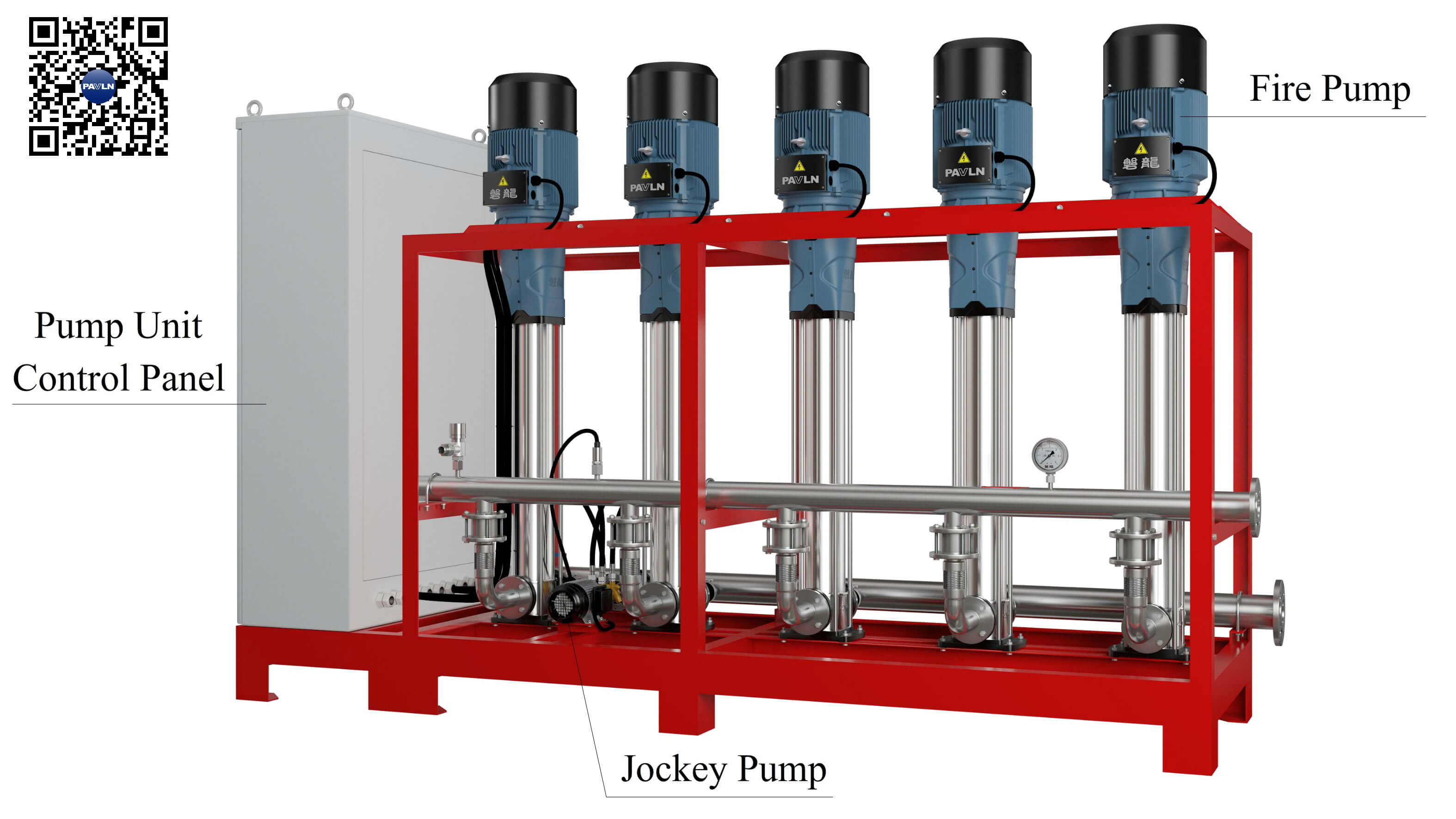
The pump unit includes filters, a water storage tank, fire pump, a jockey pump, a pump unit control panel, a safety valve, pressure monitoring devices, and a pressure-relief/regulating valve, where applicable[Figure 3] [Figure 4].
Figure 3. High-Pressure Water Mist Pump UnitFigure 4. Medium-Pressure Water Mist Pump Unit
3.3.2 Section Valves
3.3.2.1 Open Nozzle Water Mist Fire Extinguishing Systems
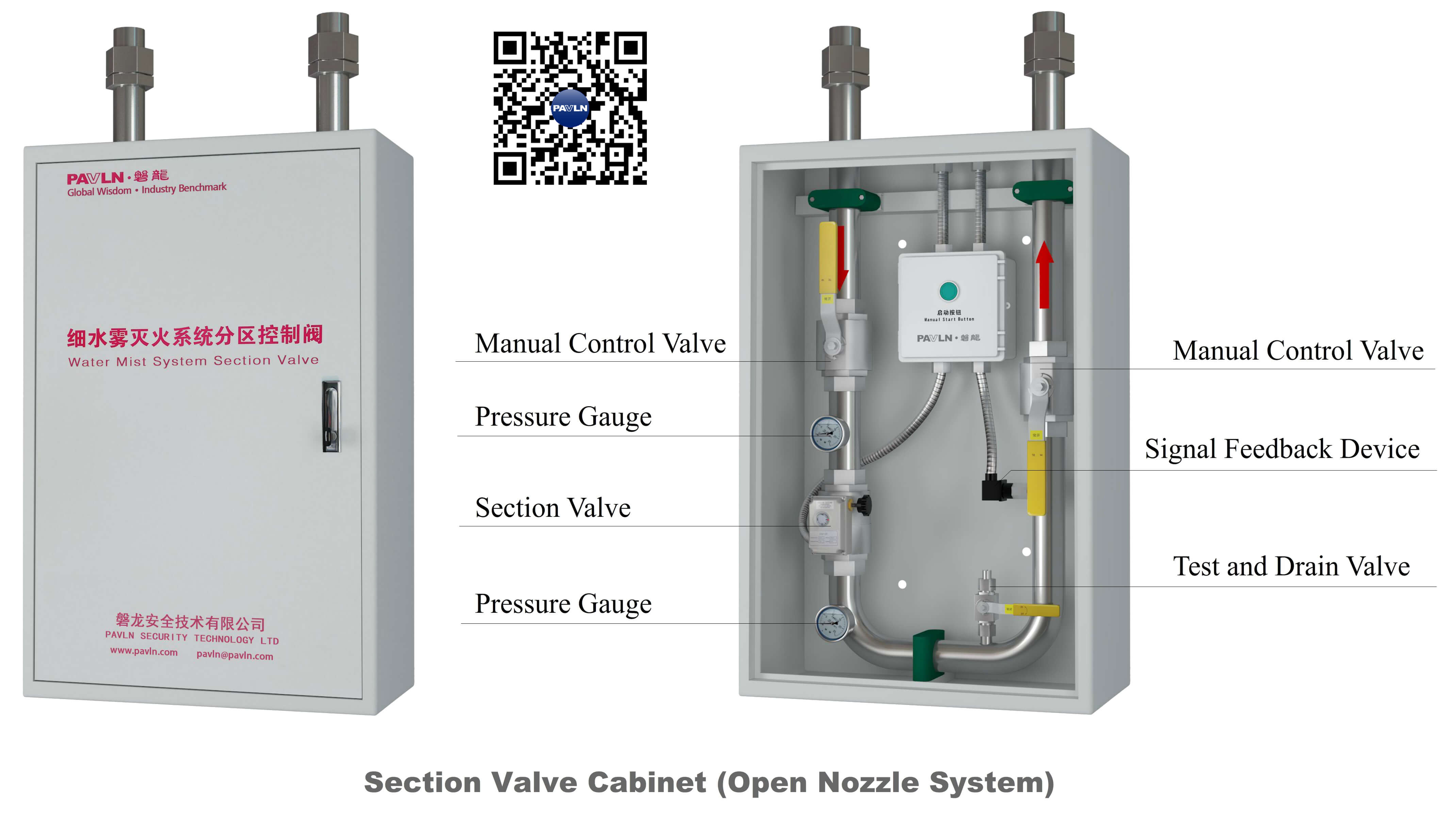
In open nozzle water mist fire extinguishing systems, the section valve remains closed under normal conditions. Upon receipt of an alarm release control signal, the valve opens, water enters the distribution piping, and the signal feedback device sends an actuation signal, after which the open water mist nozzles within the corresponding protected area or around the protected object discharge water mist simultaneously.
In Figure 5, the section valve, pressure gauge, signal feedback device, and drain-and-test valve are installed together in the valve cabinet.
3.3.2.2 Automatic Nozzle Water Mist Fire Extinguishing Systems
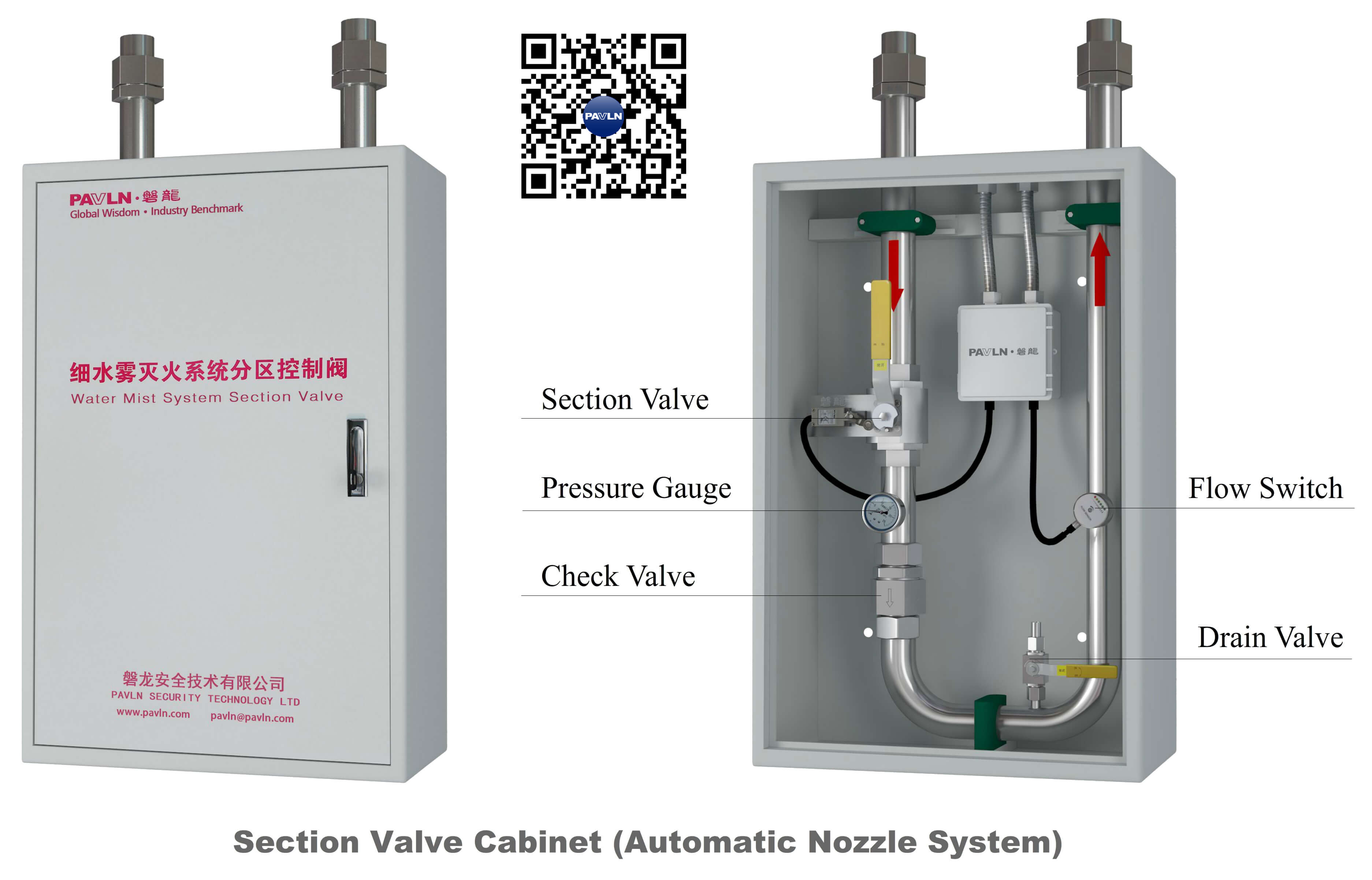
In automatic nozzle water mist fire extinguishing systems, the section valve remains normally open and is mainly used for maintenance and isolation. In the event of a fire, the automatic water mist nozzles operate upon heat activation and begin discharging water, the flow switch sends a waterflow signal, and the water mist pump unit is started according to the preset control logic. In Figure 6, the section valve, flow switch, pressure gauge, and drain valve are installed together in the valve cabinet.
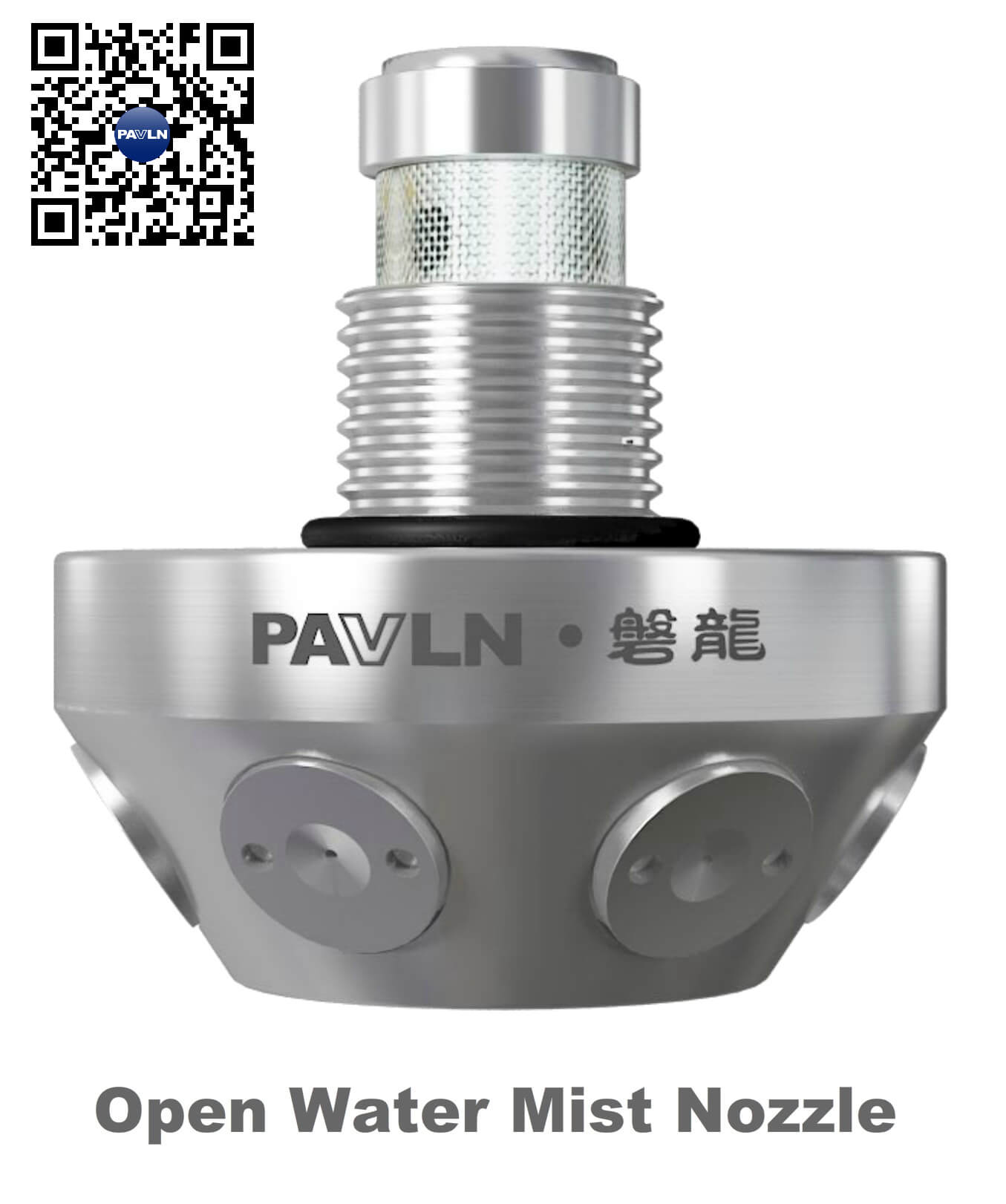
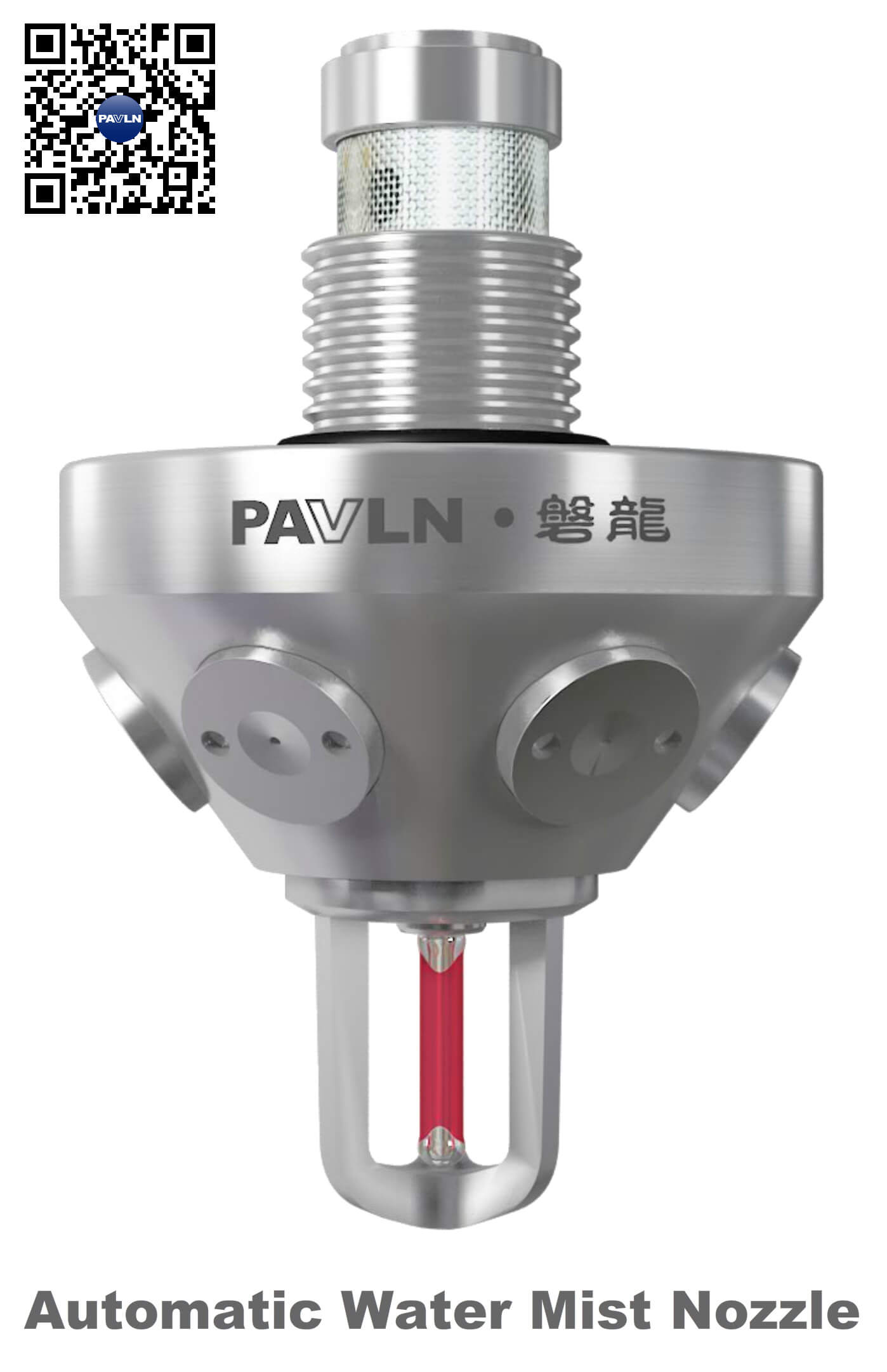
At the design operating pressure, water mist nozzles generate and discharge water mist. Open nozzle water mist fire extinguishing systems use open water mist nozzles [Figure 7]. Automatic nozzle water mist fire extinguishing systems use automatic water mist nozzles, in which the heat-sensitive element serves as the actuation component [Figure 8].
Figure 7. Open Water Mist NozzleFigure 8. Automatic Water Mist Nozzle
3.3.4 Inspector's Test Connection
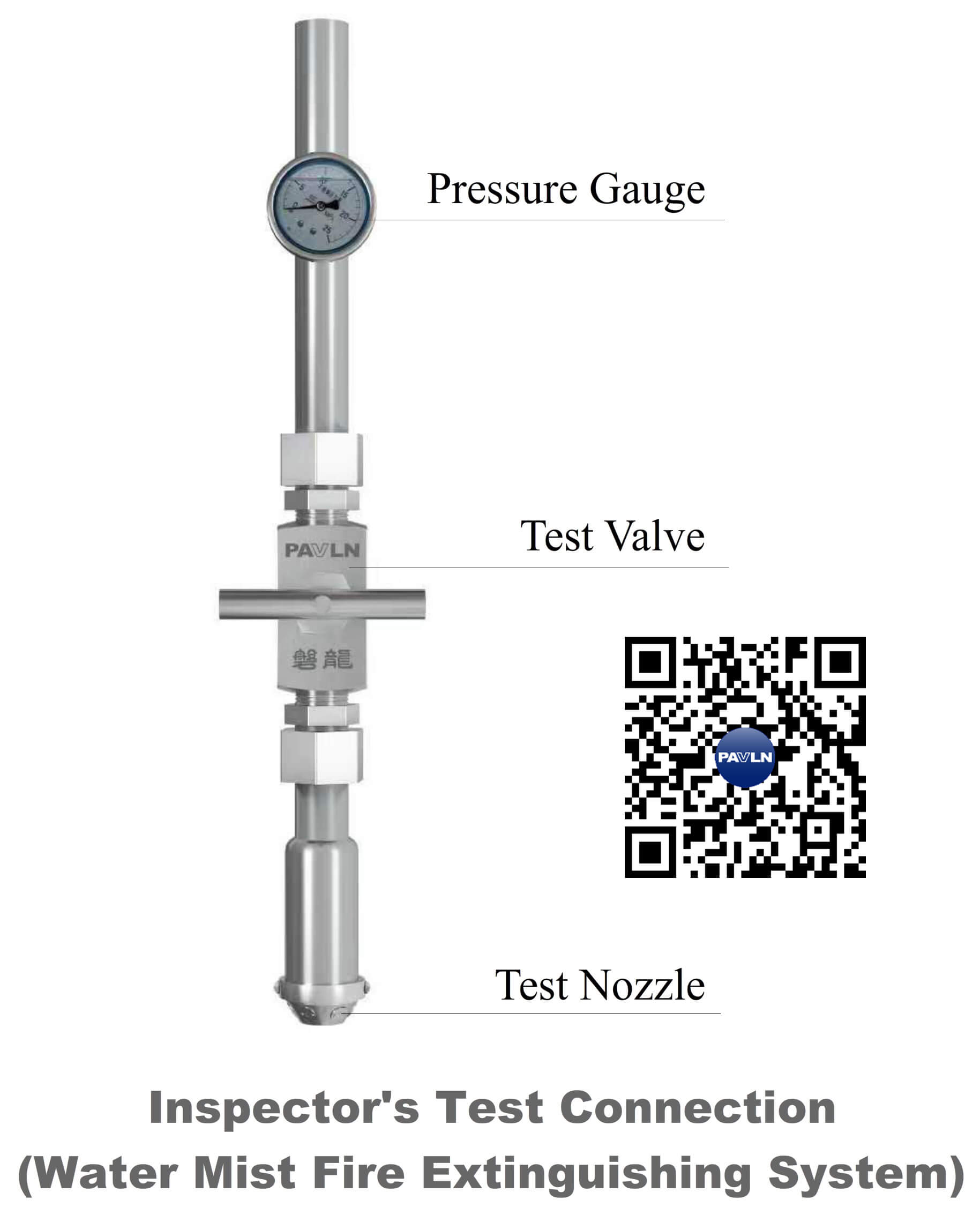
The inspector's test connection consists of a test valve, a pressure gauge, and a test nozzle [Figure 9]. It is typically installed at the end of the section piping network and is used to monitor the end pressure of the water mist fire extinguishing system, as well as to verify system start-up, alarm, and interlock functions. The discharge flow coefficient of the test nozzle shall be consistent with the smallest nozzle flow coefficient in the section.
Figure 9. Inspector's Test Connection
4. Cylinder-Supplied Water Mist Fire Extinguishing Systems
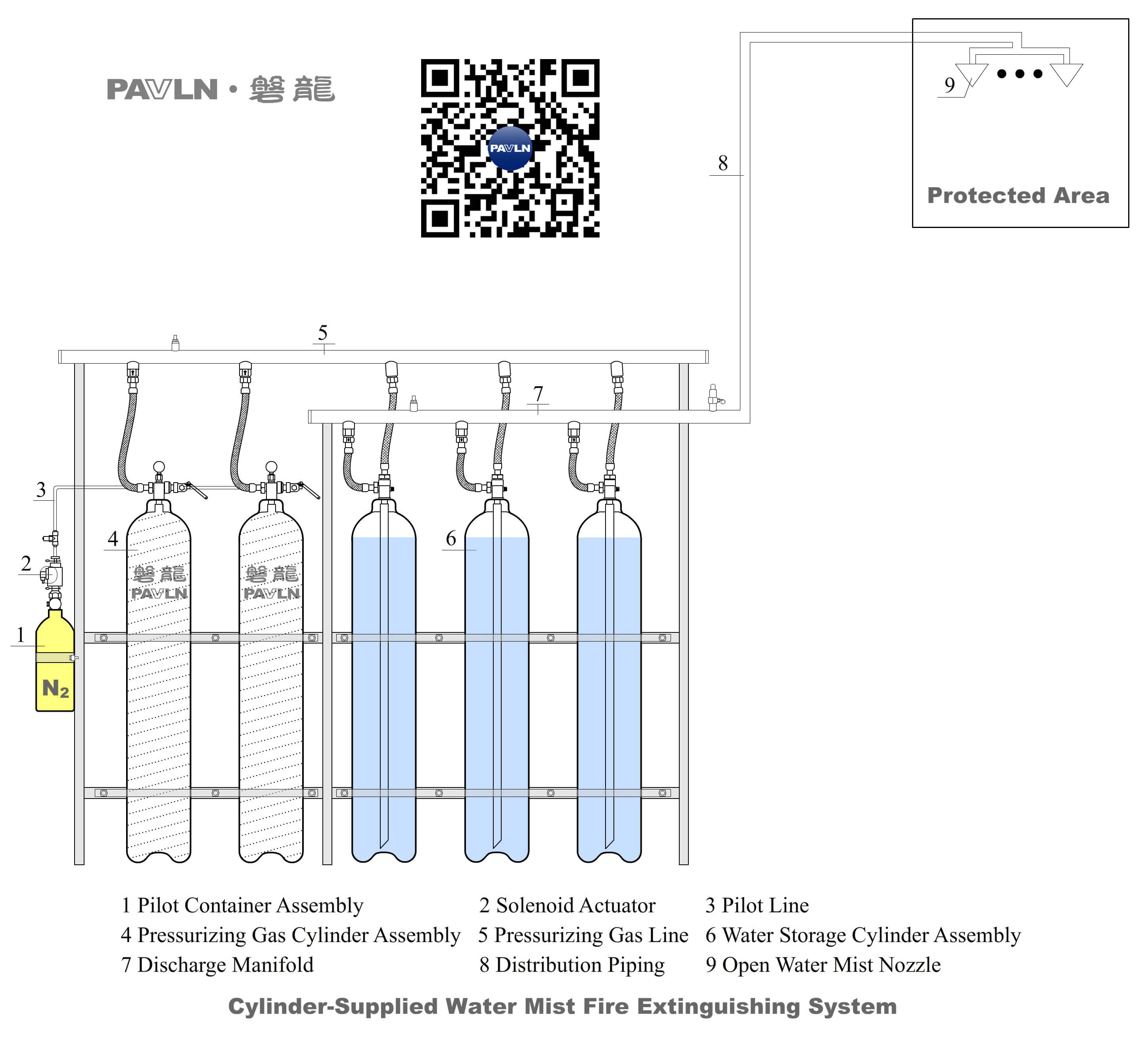
Cylinder-supplied water mist fire extinguishing systems mainly consist of water storage cylinders, gas storage cylinders, section valves, water mist nozzles, and distribution piping [Figure 10]. The gas storage cylinders are used to store the driving gas, while the water storage cylinders are used to store water for fire extinguishing. In the event of a fire, the fire alarm and control system is activated, and the driving gas forces water through the piping to the nozzles, where it is atomized into water mist.
This type of system has limited continuous water supply capacity and is therefore suitable only for open nozzle systems.
Figure 10. Cylinder-Supplied Water Mist Fire Extinguishing System
5. Typical Applications
Water mist fire extinguishing systems are suitable for applications with high requirements for fire extinguishing efficiency, water damage control, and equipment protection. Typical applications include the following: