
1. Basic Concept

Water spray systems for fire protection were developed on the basis of automatic sprinkler systems. Their system arrangement and control method are similar to those of deluge systems, with the main difference being the type of nozzle used. Deluge systems normally use open sprinklers to discharge relatively large water droplets or solid water streams over the protected area, whereas water spray systems for fire protection use water spray nozzles to discharge water under pressure as droplets or spray streams with specific momentum and atomization characteristics. Through cooling, smothering, emulsification and dilution, they provide fire extinguishment, fire control, or protective cooling for the protected object or exposed surface.

Water spray systems for fire protection are mainly suitable for hazards where fire may spread rapidly, water is appropriate, and conventional automatic sprinkler systems cannot provide effective protection.

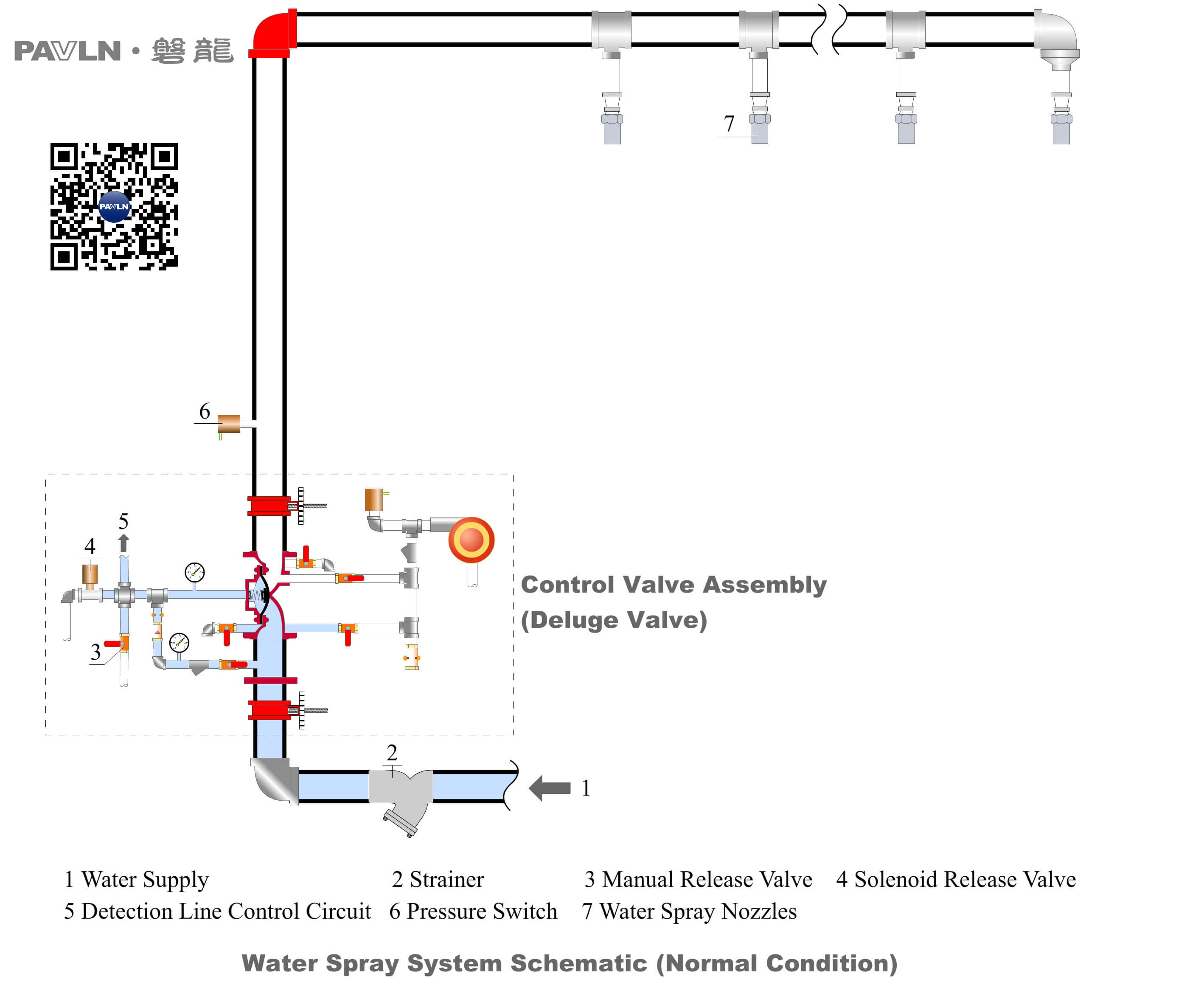
Figure 1. Schematic diagram of a water spray system for fire protection. The system mainly consists of a water supply, control valve assembly, piping and water spray nozzles.

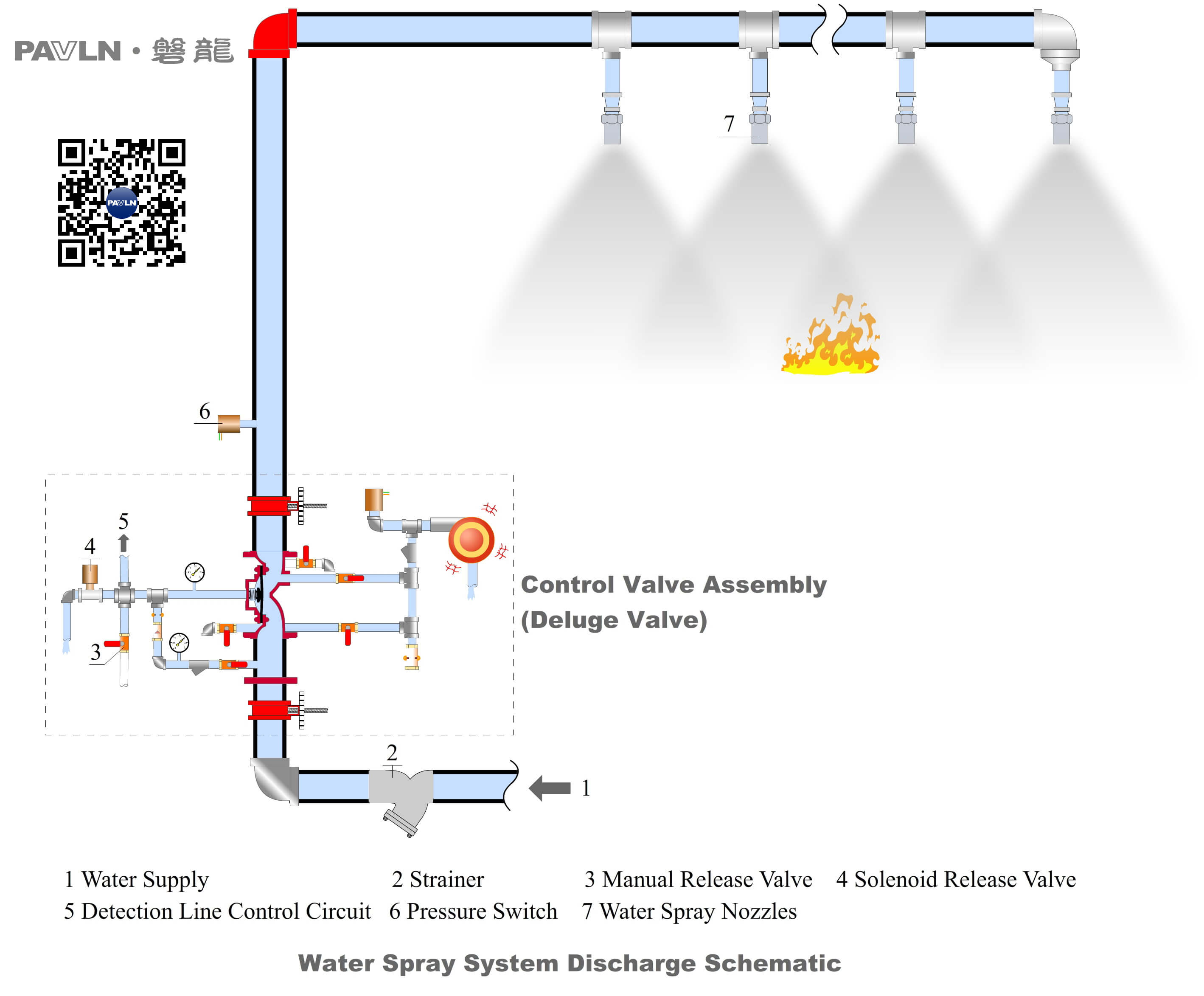
Figure 2. Discharge Pattern of a Water Spray System for Fire Protection. In the event of a fire, the control valve assembly opens, and water is delivered through the piping to the water spray nozzles for discharge and fire suppression.
2. Water Supply

The water supply shall provide the water spray fire protection system with the required fire water flow rate, pressure, and quantity in accordance with the design requirements. The water supply may be provided by facilities such as a fire water storage tank and fire pumps, or by a compliant fire water supply network or municipal water supply network.

3. Control Valve Assembly

Deluge valves are typically used as the control valve assembly for water spray systems. Where required by the application, other electrically actuated control valves having equivalent control functions may also be used. Deluge valves are commonly applied where rapid system operation is required and where the system is intended for fire extinguishment.

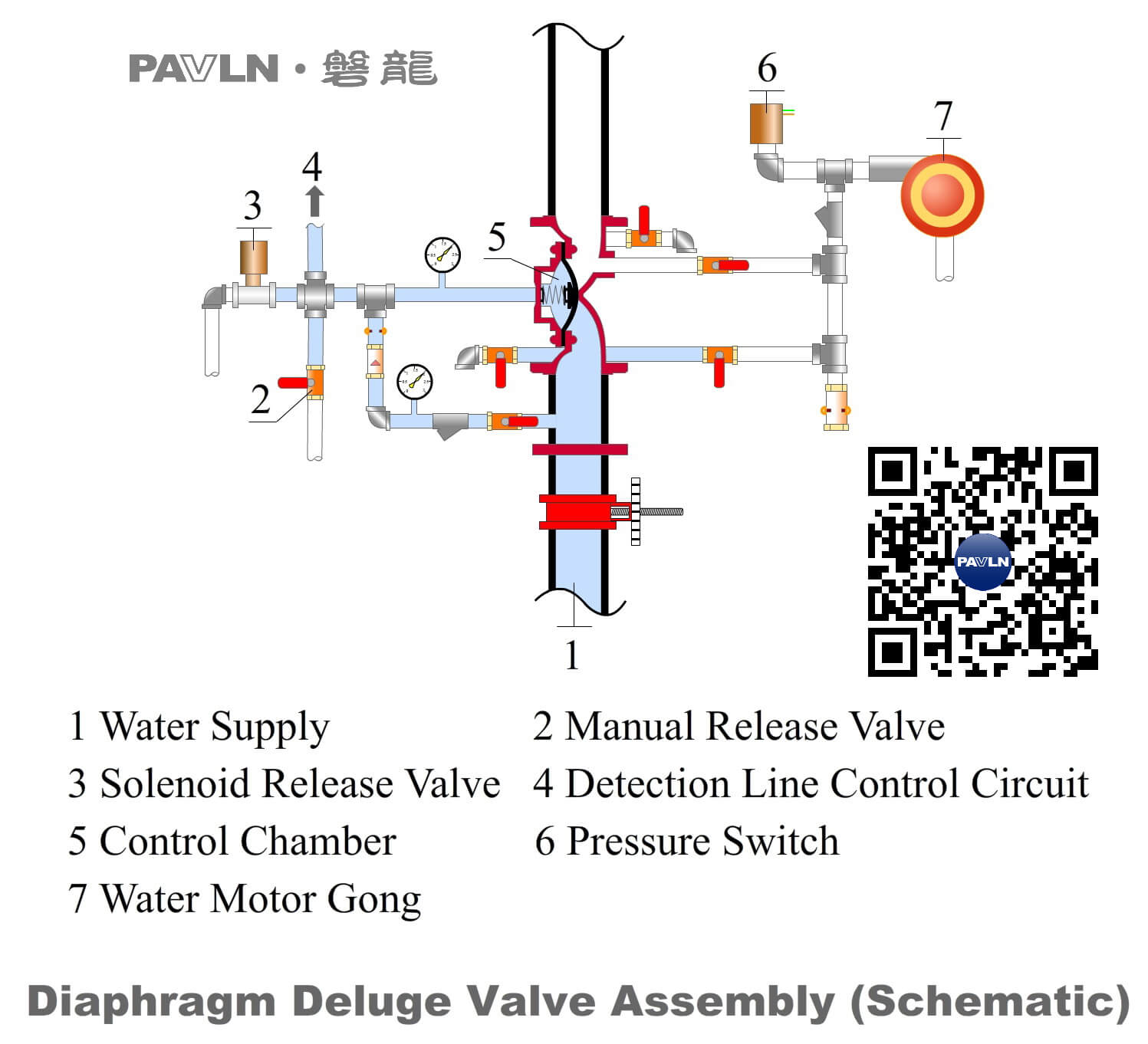
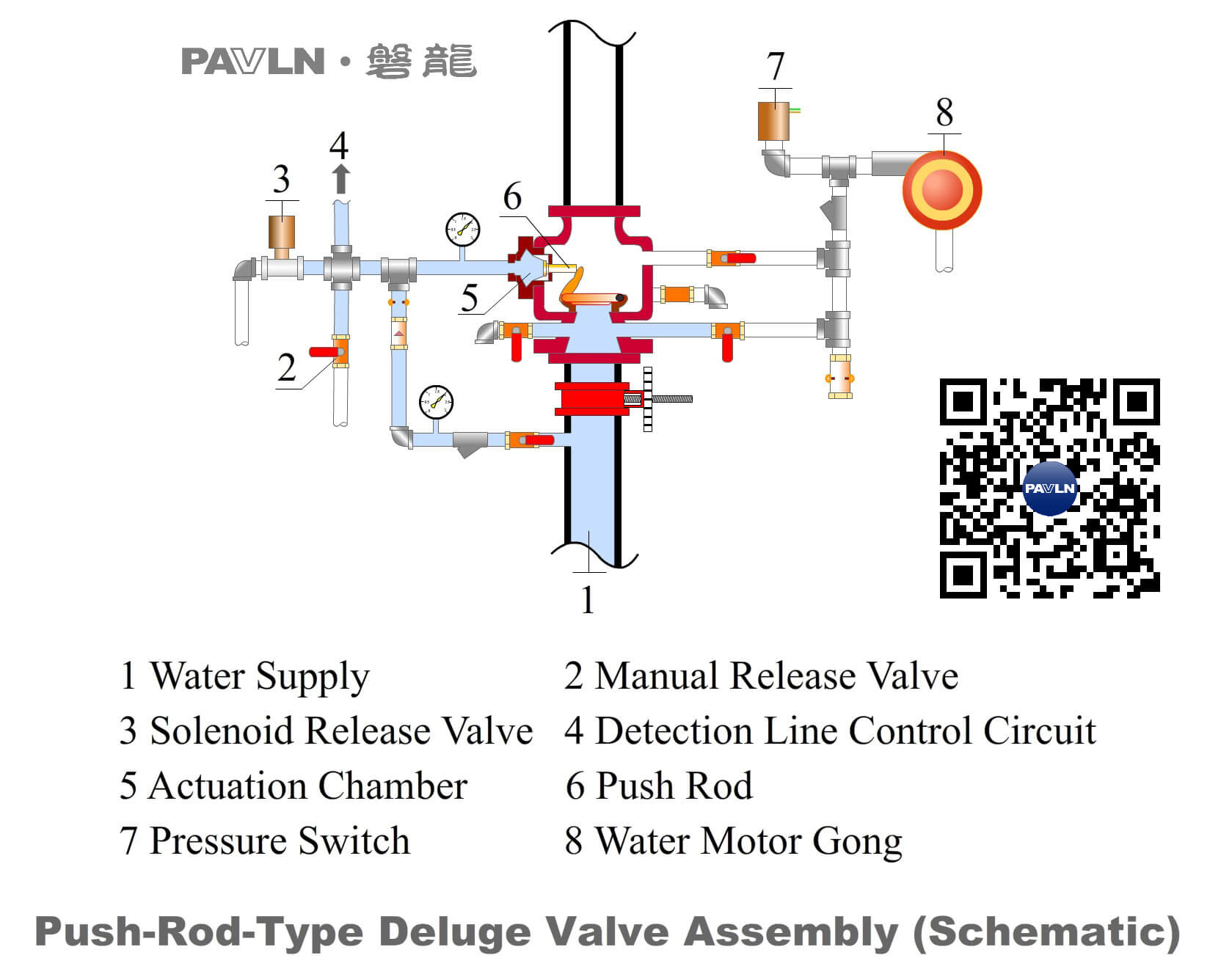
The deluge valve assembly is held closed by pressure maintained in the control chamber. Under normal supervisory conditions, this pressure keeps the main valve in the closed position. In diaphragm-type deluge valves, the control chamber pressure acts directly on the diaphragm to keep the valve closed [Figure 3]. In push-rod-type deluge valves, the control chamber pressure holds the main valve closed through a push rod or latch arrangement [Figure 4]. When the control chamber pressure is released, the main valve opens under water supply pressure, permitting water to enter the system piping and discharge through the open water spray nozzles.

Control chamber pressure may be released electrically by a solenoid valve, mechanically by a manual release valve, or remotely through hydraulic or pneumatic release lines. Remote release may be initiated by heat-responsive closed sprinklers in the protected area or by a remotely located manual release device installed in a safe area.

4. Water Spray Nozzles

Water spray nozzles discharge water in a defined spray pattern under pressure to protect the hazard or protected area as required by the system design.

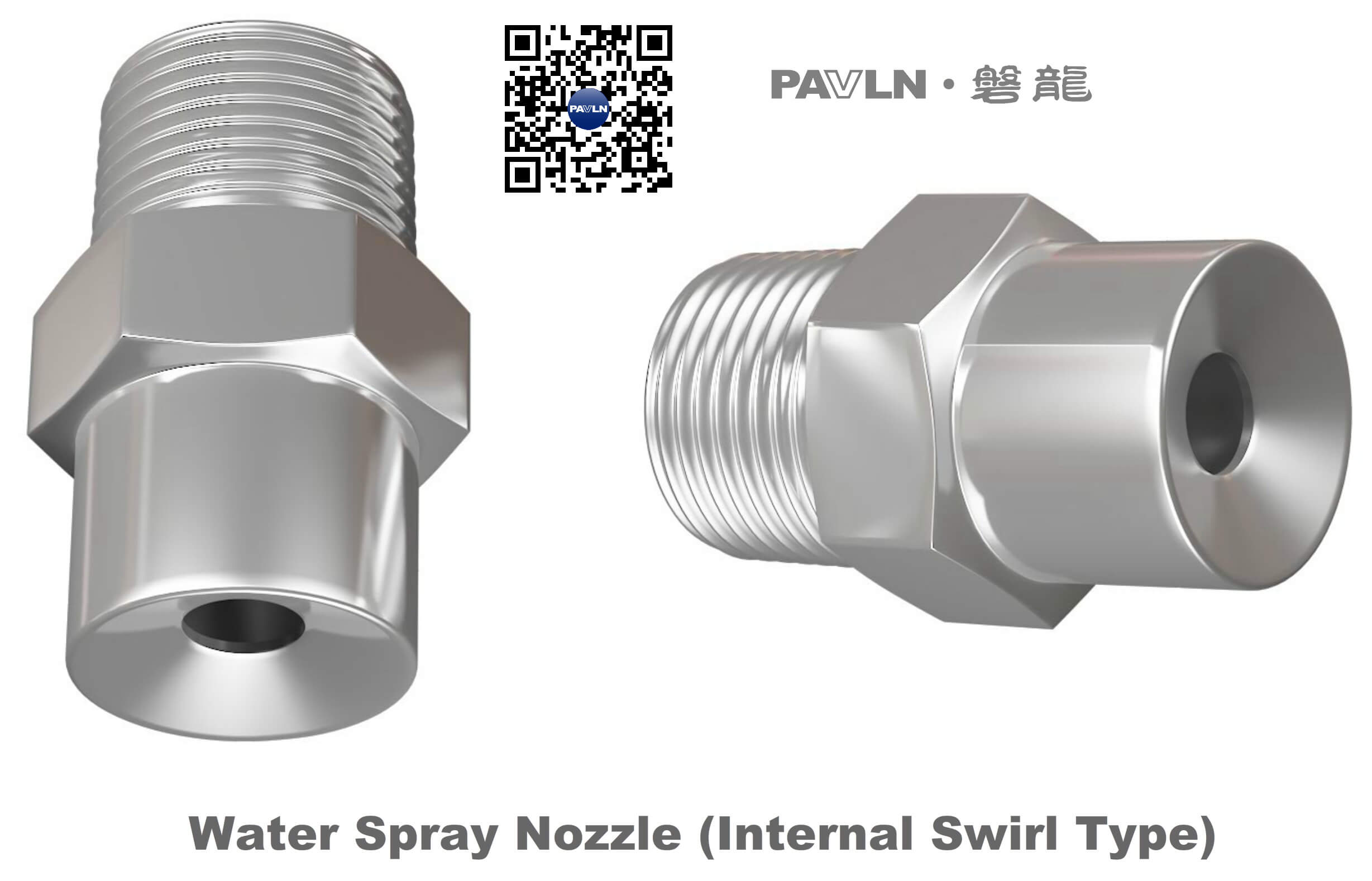
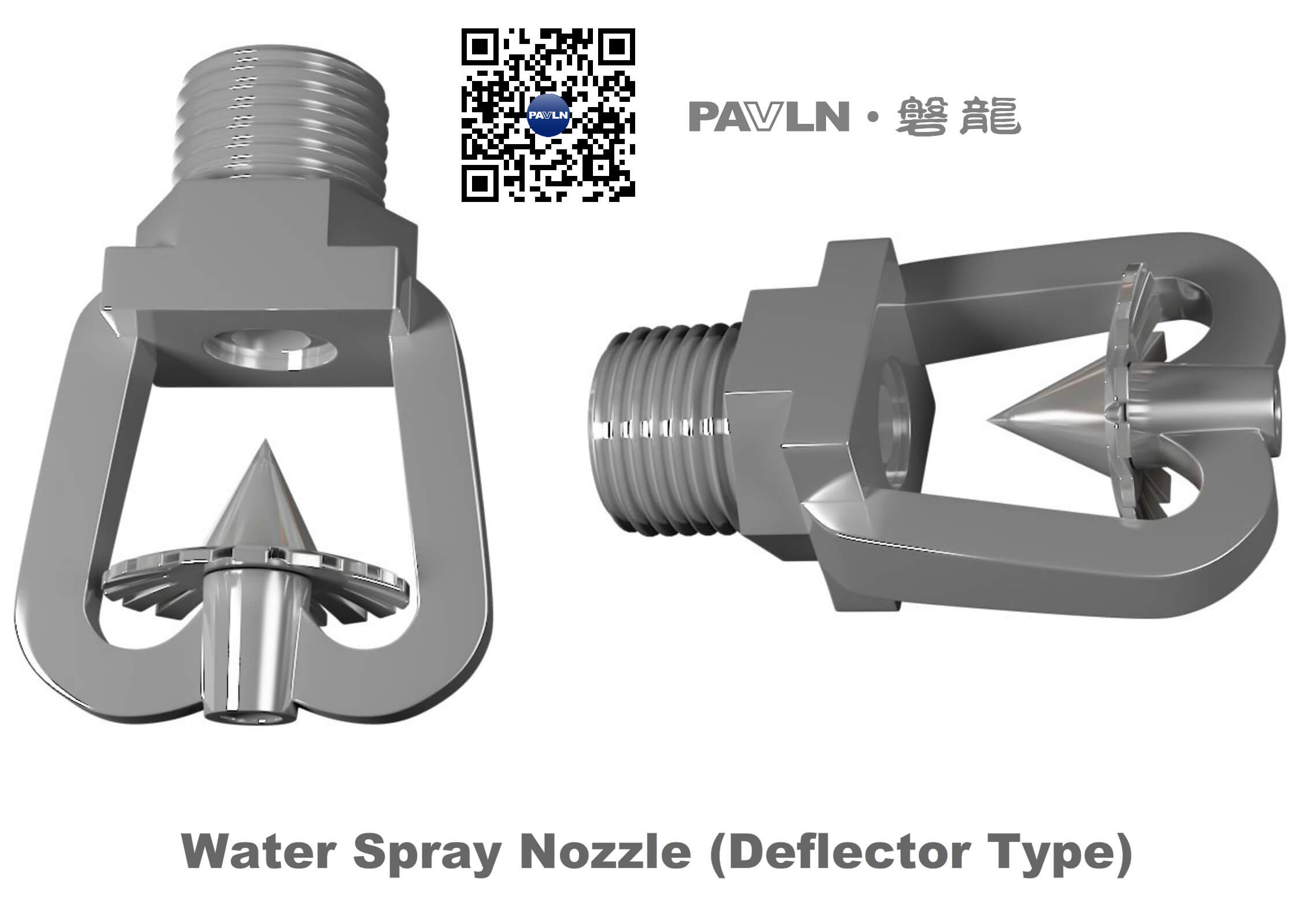
Water spray nozzles are commonly available in different construction types and spray characteristics. In practice, some nozzles produce spray through internal swirl components, while others form spray by deflecting the water stream against a deflector. These nozzle types differ in droplet formation, spray distribution, and application characteristics [Figure 5] [Figure 6].

Nozzles with internal swirl features typically produce finer droplets and a more discontinuous spray pattern, and are often considered suitable for applications where electrical insulation performance is important, such as the protection of electrical equipment.

5. Electric Release and Pilot Line Release

As noted above, a deluge valve assembly may be electrically released through a solenoid valve, or remotely released through hydraulic or pneumatic pilot lines.

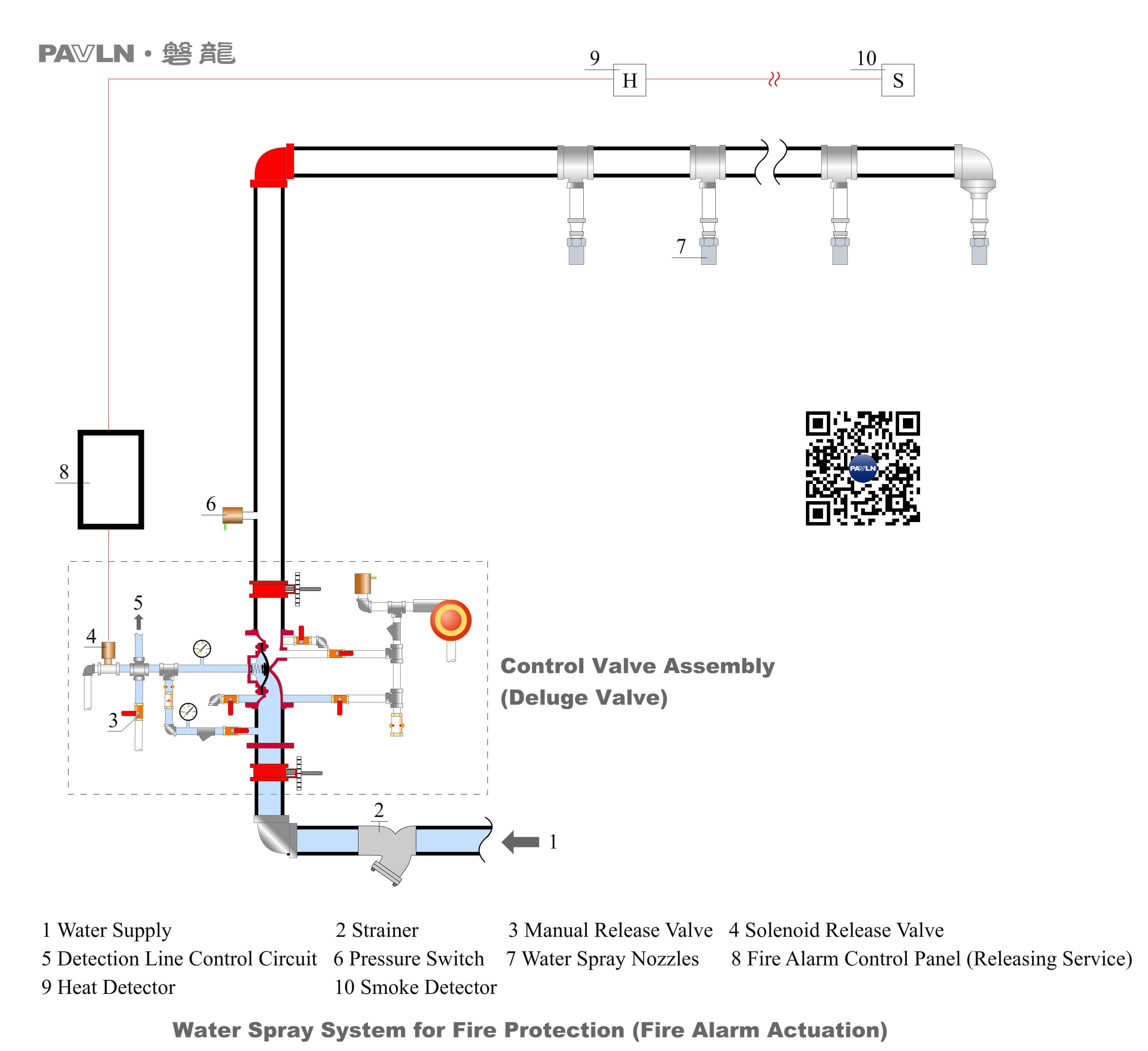
Water spray systems are typically provided with an automatic fire detection system, with the fire alarm signal actuating the solenoid valve for electric release [Figure 7].

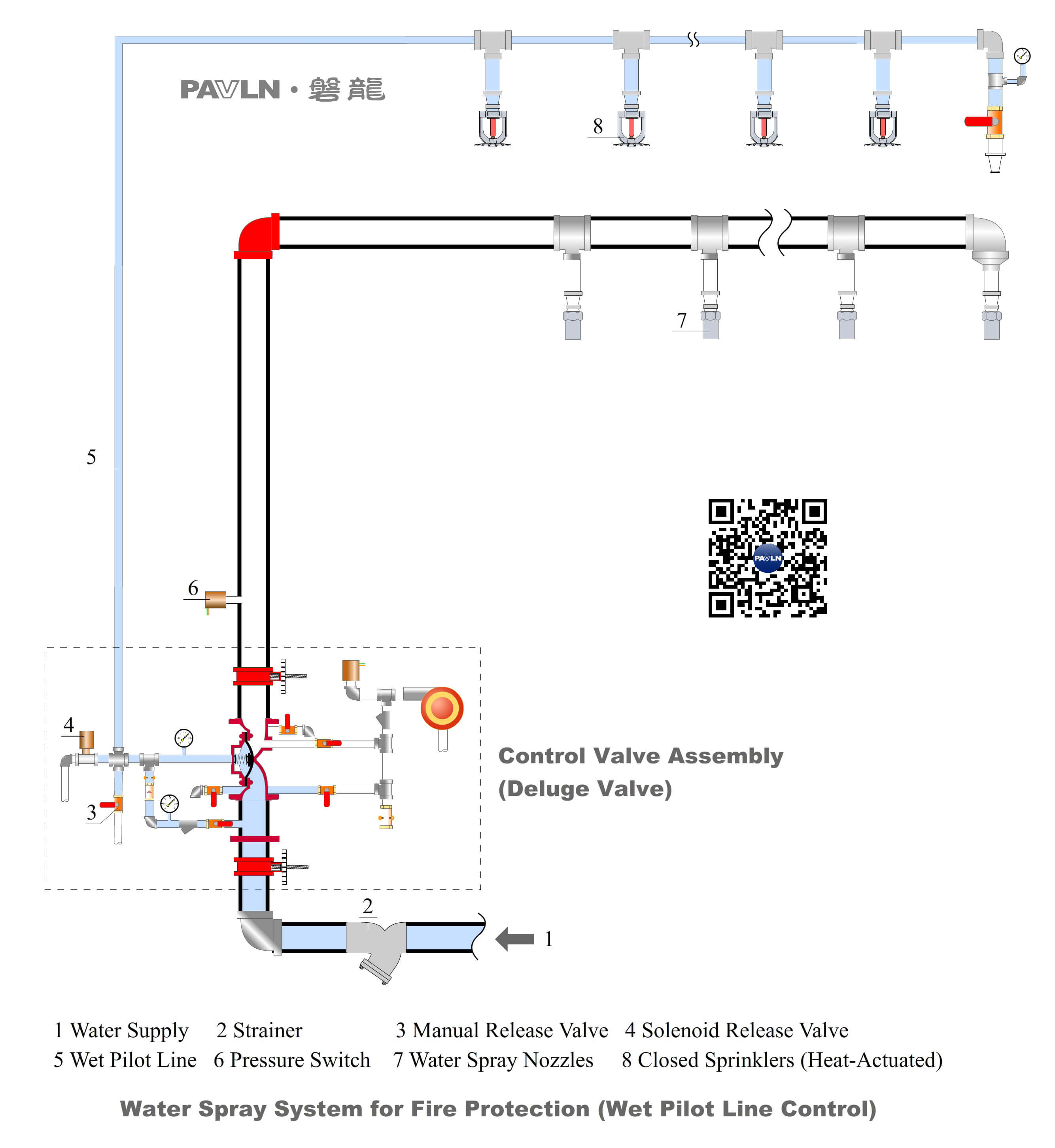
In locations where an automatic fire detection system is not practical, closed sprinklers or other heat-responsive devices may be installed in the protected area as fire detection devices to initiate release through a wet pilot line [Figure 8]. Where elevation differences are significant, or where a wet pilot line is not suitable, a water-to-air interface device may be provided to permit release through a dry pilot line.

6. Typical Applications

Water spray systems are used for the protection of hazards involving ordinary combustibles, flammable liquids, and energized electrical equipment, and may also be applied for exposure protection and cooling of high-risk facilities such as liquefied hydrocarbon storage tanks. They are widely used in the petrochemical, power generation, and metallurgical industries. Typical applications include oil-immersed transformers, oil-filled electrical equipment, flammable liquid storage tanks, liquefied hydrocarbon storage tanks, conveyors, cable tunnels, and other facilities or areas requiring fire protection and surface cooling.

7. Water Spray Systems and Water Mist Systems

Water spray systems and water mist systems are both water-based fire protection systems that enhance fire suppression performance by discharging water in the form of droplets. However, they are governed by different standards and differ significantly in nozzle characteristics, extinguishing mechanisms, and typical applications.

Water spray systems generally produce larger droplets and primarily rely on continuous discharge onto the protected surface to achieve cooling, smothering, emulsification, and dilution effects. Water mist systems produce much finer droplets and place greater emphasis on heat absorption through droplet evaporation, steam dilution, and radiant heat attenuation. As a result, water mist systems generally offer greater adaptability to enclosed or complex spaces, higher extinguishing efficiency, and reduced water damage.