

2.1 HFC-227ea Agent
HFC-227ea is a synthetic halocarbon clean agent. Its fire suppression mechanism is primarily based on chemical inhibition, while also providing a certain cooling effect through heat absorption.
Professional Solutions for Gas Fire Extinguishing Systems
Gas fire extinguishing systems are fixed fire protection systems that use gaseous agents as the extinguishing medium. They provide rapid fire extinguishment, leave no residue after discharge, are non-conductive, and cause minimal contamination to equipment. They are mainly used in locations where water-based fire protection systems are unsuitable, or where no post-discharge residue is permitted.
The following videos use HFC-227ea as an example to illustrate the discharge sequence of a pre-engineered gas fire extinguishing system and a piped gas fire extinguishing system.
HFC-227ea is a synthetic halocarbon clean agent. Its fire suppression mechanism is primarily based on chemical inhibition, while also providing a certain cooling effect through heat absorption.
FK-5-1-12 is a synthetic halocarbon clean agent. Its fire suppression mechanism is primarily based on heat absorption and cooling, while also providing a certain degree of chemical inhibition.
Inert gas agents mainly include IG-541, IG-55, IG-100, and IG-01. Their primary fire suppression mechanism is to reduce the oxygen concentration within the protected enclosure so that combustion cannot be sustained.
Consists solely of argon.
Consists solely of nitrogen.
Consists of 50% argon and 50% nitrogen.
Consists of 52% nitrogen, 40% argon, and 8% carbon dioxide.
Carbon dioxide suppresses fire primarily by reducing the oxygen concentration, while also providing a certain cooling effect. Because carbon dioxide presents a significant asphyxiation hazard to personnel, it is generally used only in normally unoccupied or lightly occupied areas.
Gas fire extinguishing systems can be classified by structural configuration into pre-engineered gas fire extinguishing systems and piped gas fire extinguishing systems. Piped gas fire extinguishing systems can be further classified into unit-independent systems and combined distribution systems.
Pre-engineered gas fire extinguishing systems, also referred to as non-piped gas fire extinguishing systems, are systems in which the agent storage device, discharge components, and related parts are pre-designed and assembled as a complete unit. These systems are usually installed directly within the protected area and discharge the extinguishing agent directly into the protected area without the use of piping. Installation is convenient; however, agent distribution is relatively less uniform, so these systems are mainly suitable for smaller protected spaces.
The main forms of pre-engineered gas fire extinguishing units include Hanging-Type Gas Fire Extinguishing Units and Cabinet-Type Gas Fire Extinguishing Units.
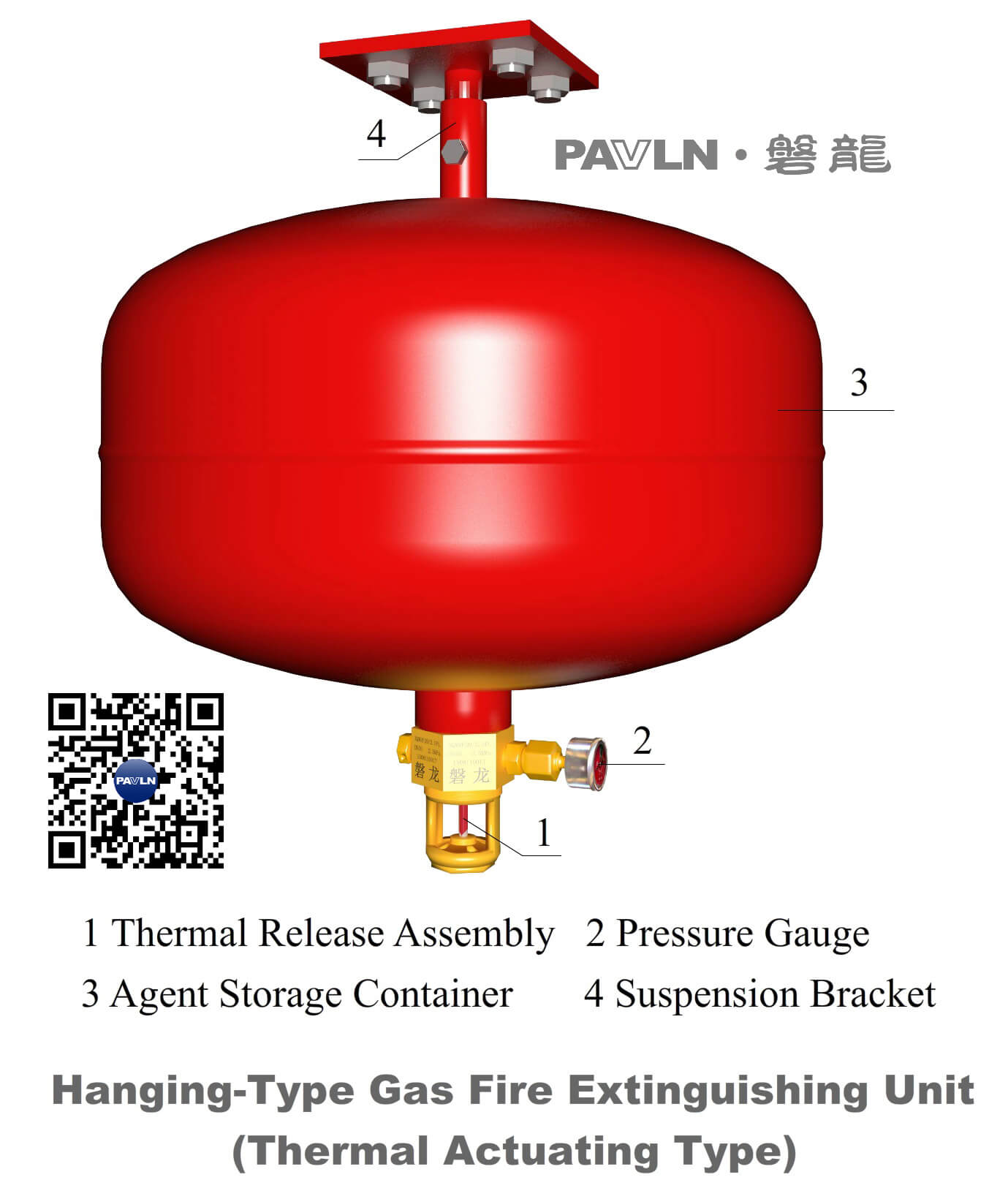
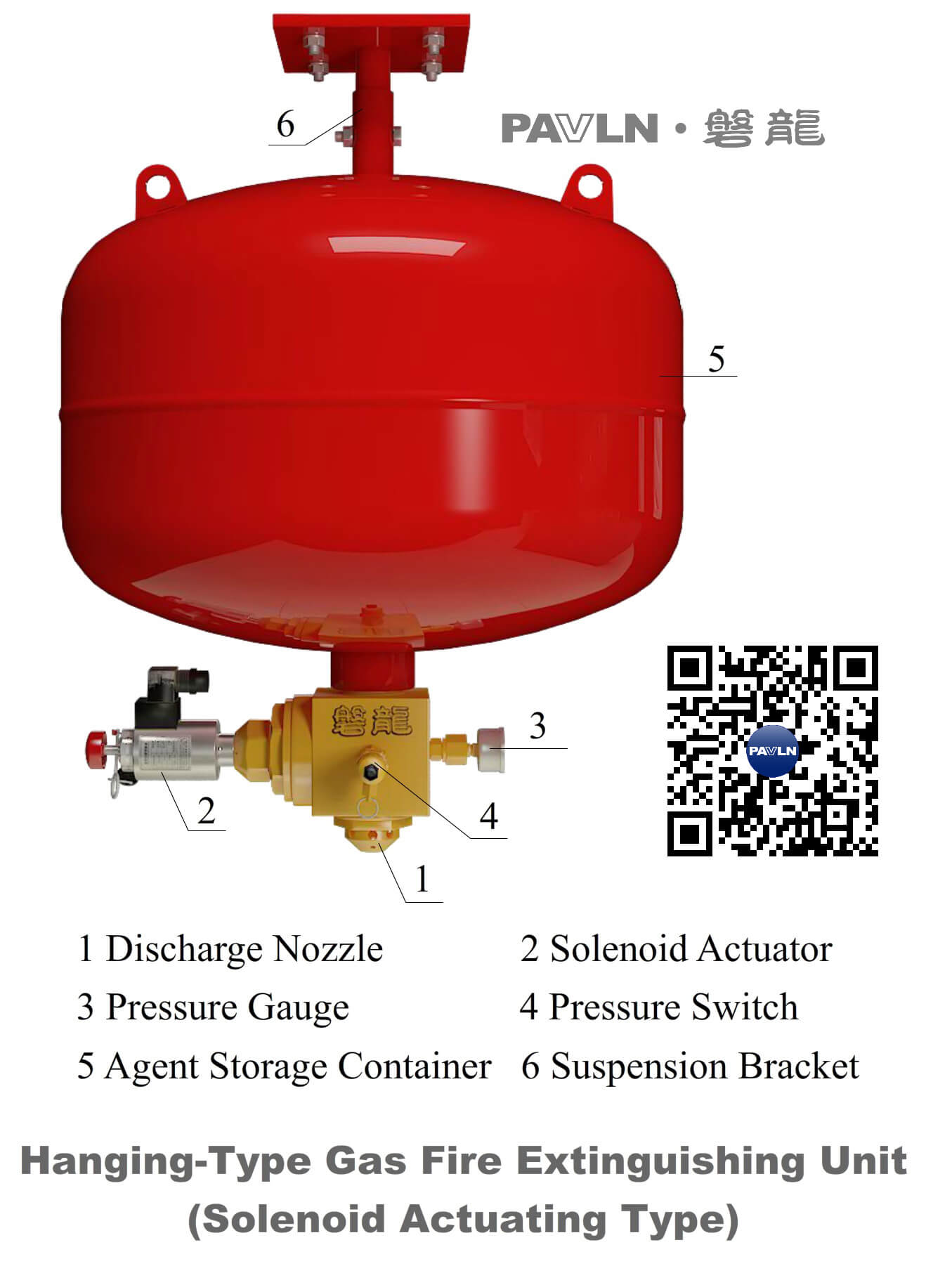
The Hanging-Type Gas Fire Extinguishing Unit consists of an agent container, an actuation and release assembly, and a hanging bracket, and may be installed in a suspended or wall-mounted arrangement [Figure 1] [Figure 2].
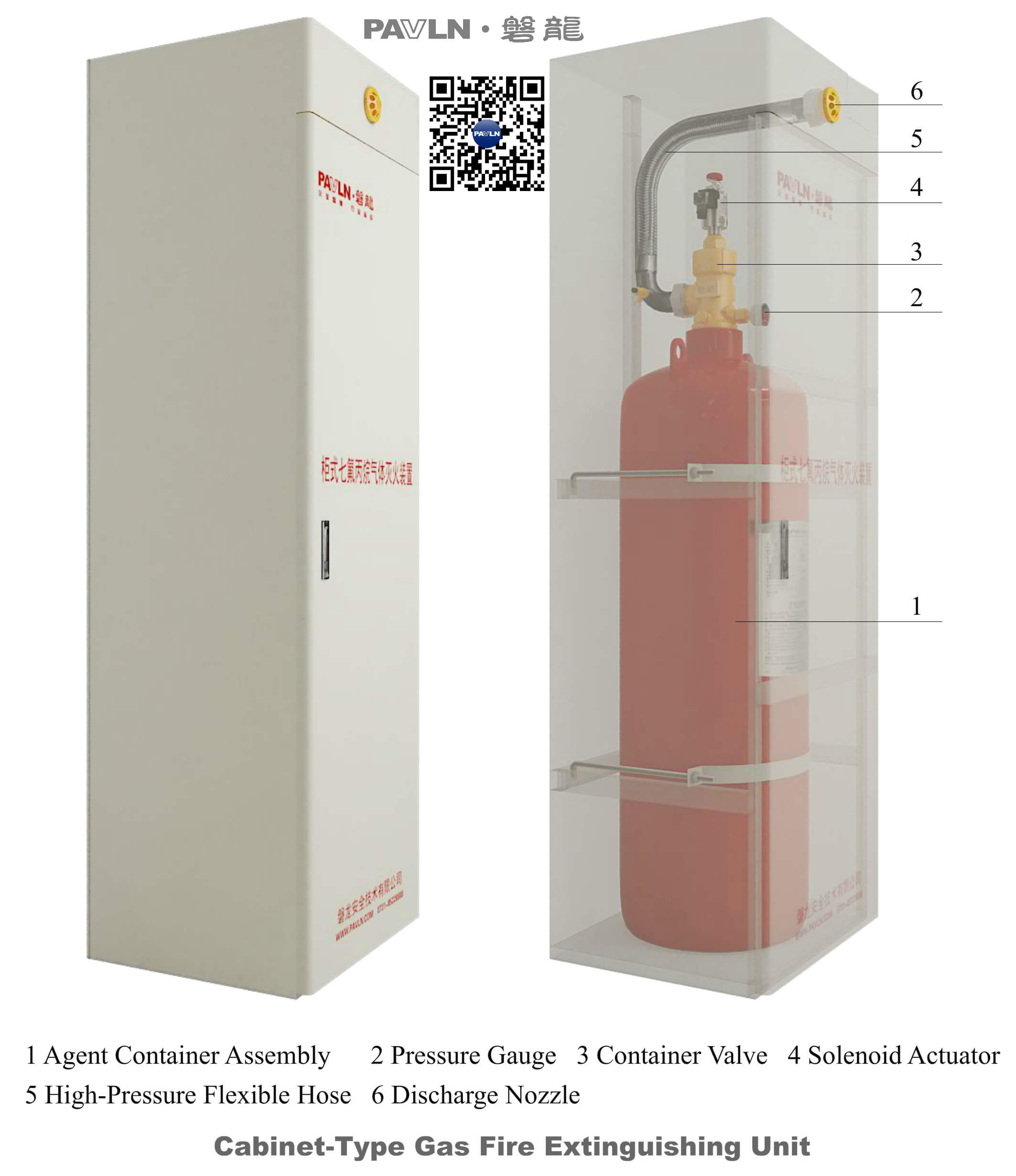
The Cabinet-Type Gas Fire Extinguishing Unit houses the agent container assembly, actuation device, pressure switch, and associated fittings within a cabinet, and discharges the extinguishing agent through nozzle(s) mounted on the cabinet [Figure 3].
Piped gas fire extinguishing systems are designed and calculated according to specific application conditions, with the extinguishing agent conveyed from the storage device through the main pipe and branch pipes to the discharge components for release.
Based on the distribution arrangement, piped gas fire extinguishing systems can be classified into unit-independent systems and combined distribution systems.
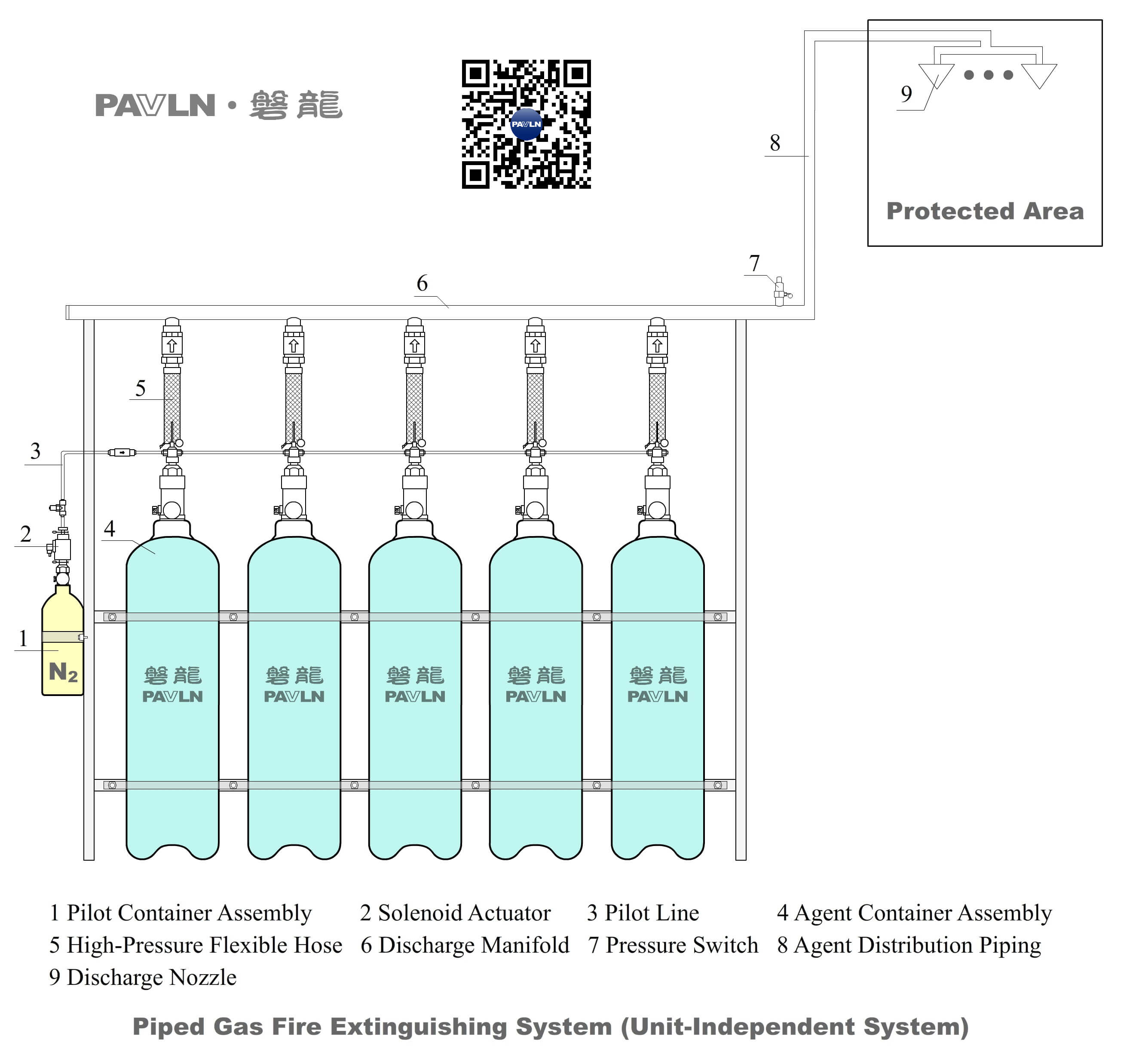
In a unit-independent system, one set of agent storage devices protects one protected area or one protected object. This arrangement provides relatively high system reliability [Figure 4].
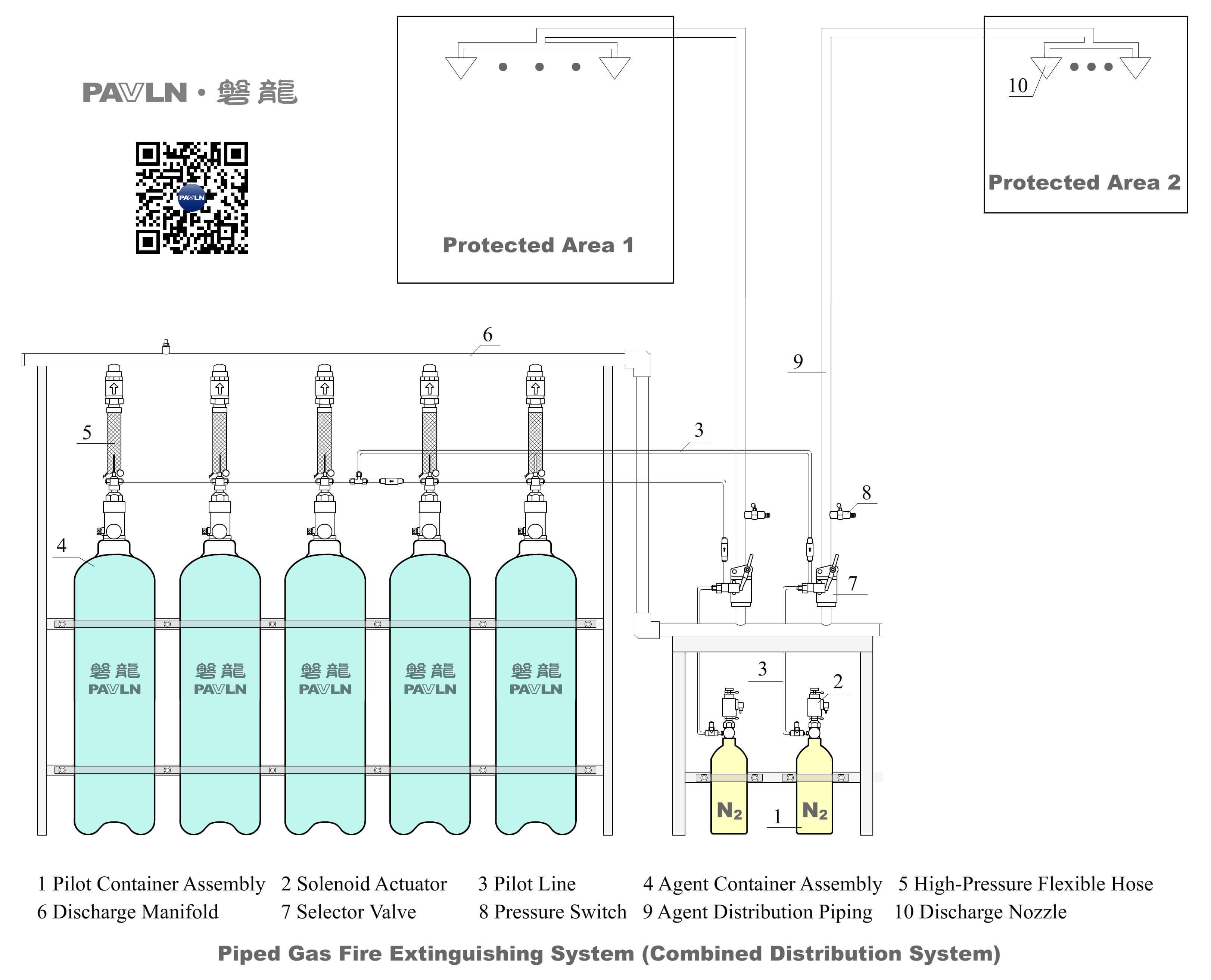
In a combined distribution system, one set of agent storage devices protects two or more protected areas through selective distribution within the piping network. When a fire occurs in any one of the protected areas, the system can discharge the extinguishing agent to that area and meet the design requirements.
This arrangement can reduce equipment quantity and installation space, thereby helping reduce project cost. However, compared with a unit-independent system, system reliability is relatively lower. In [Figure 5], two protected areas share one set of agent storage devices, and combined distribution is achieved through selector valves.
According to the method of application, gas fire extinguishing systems can be divided into total flooding systems and local application systems.
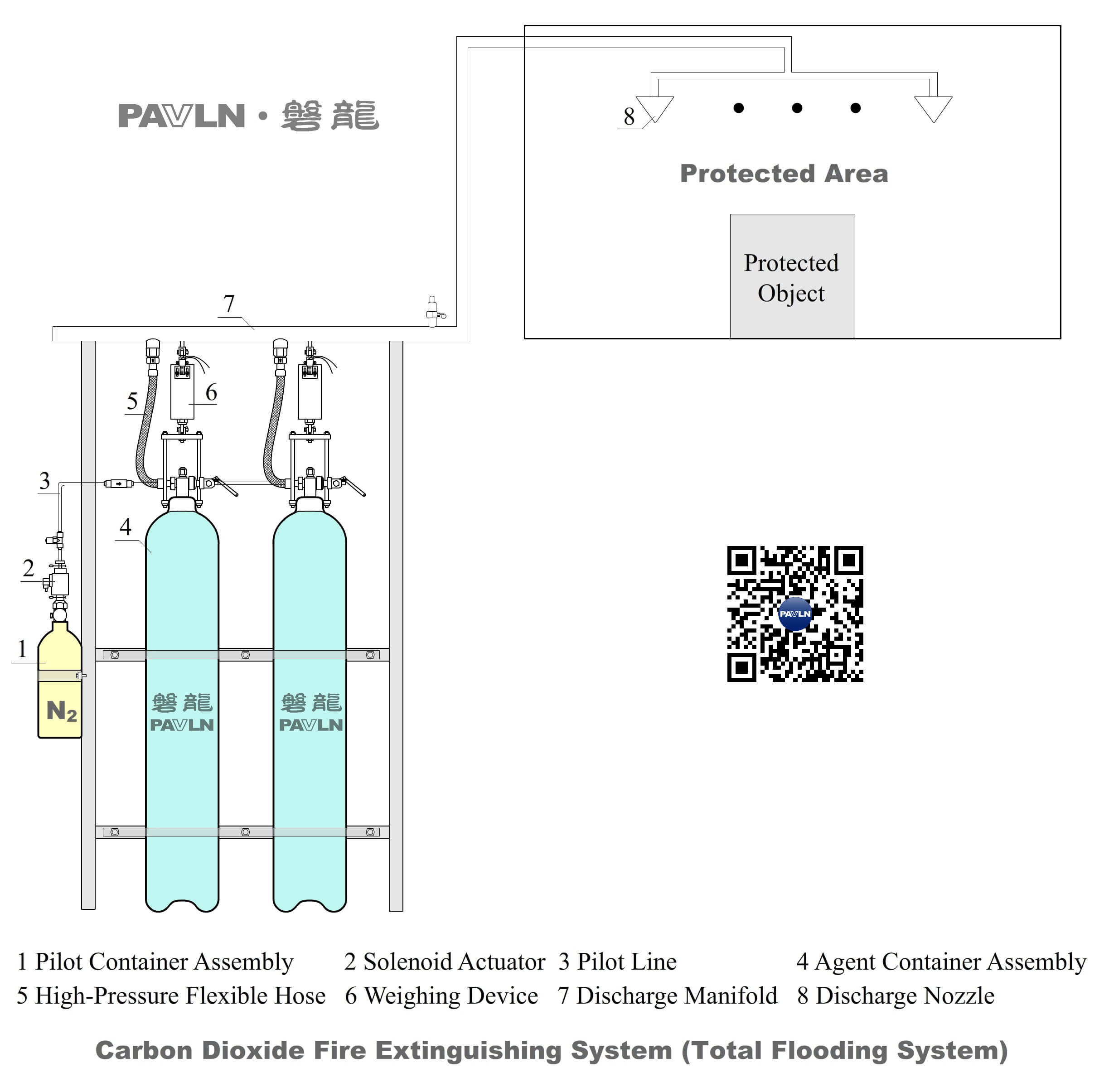
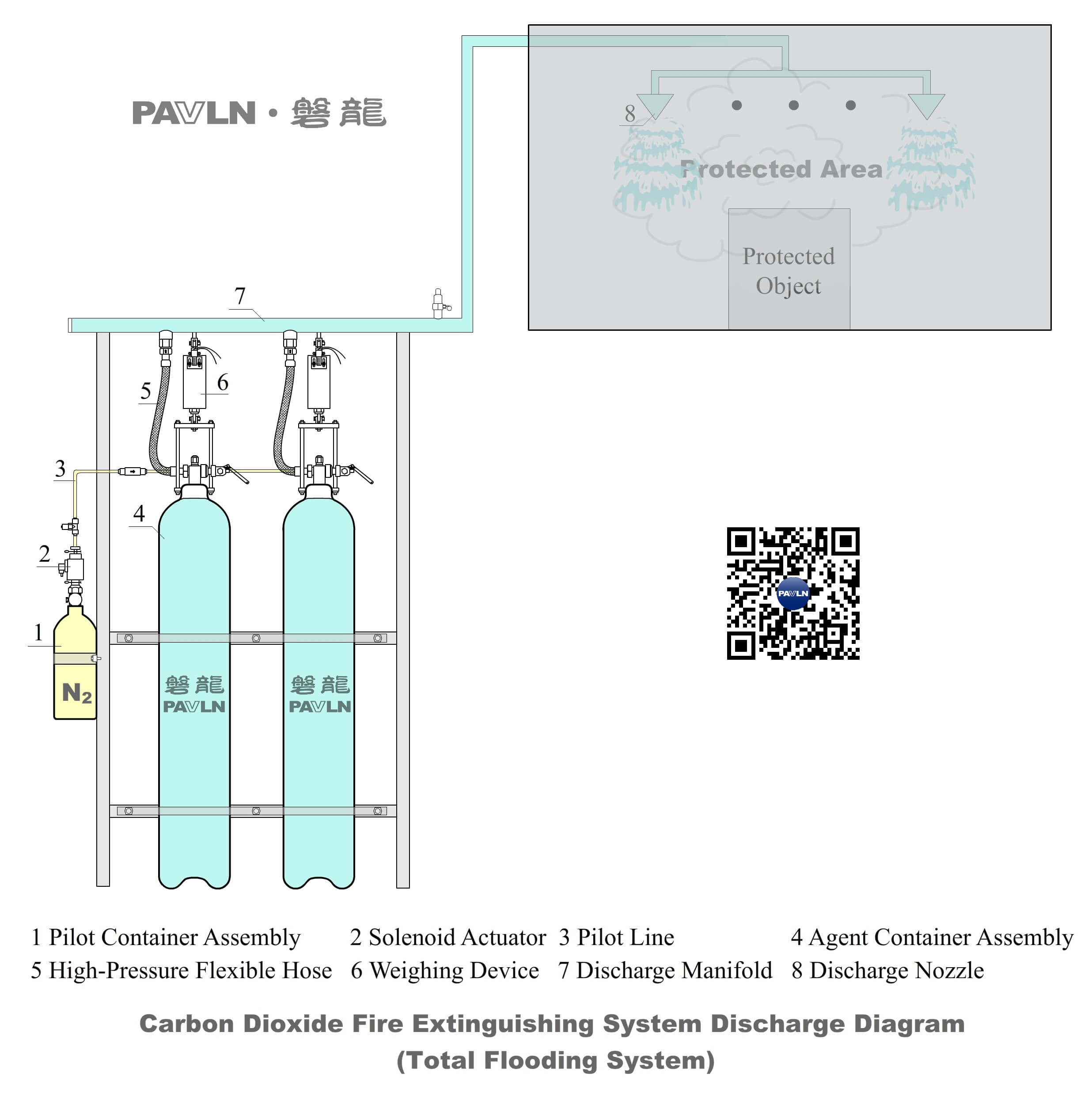
Total flooding systems are fire extinguishing systems that discharge the designed quantity of extinguishing agent into the protected area within a specified time so that the agent fills the entire protected area.
[Figure 6] and [Figure 7] use a carbon dioxide fire extinguishing system as an example to illustrate the arrangement and discharge condition of a total flooding system. When the system is discharged, the extinguishing agent fills the entire protected area.
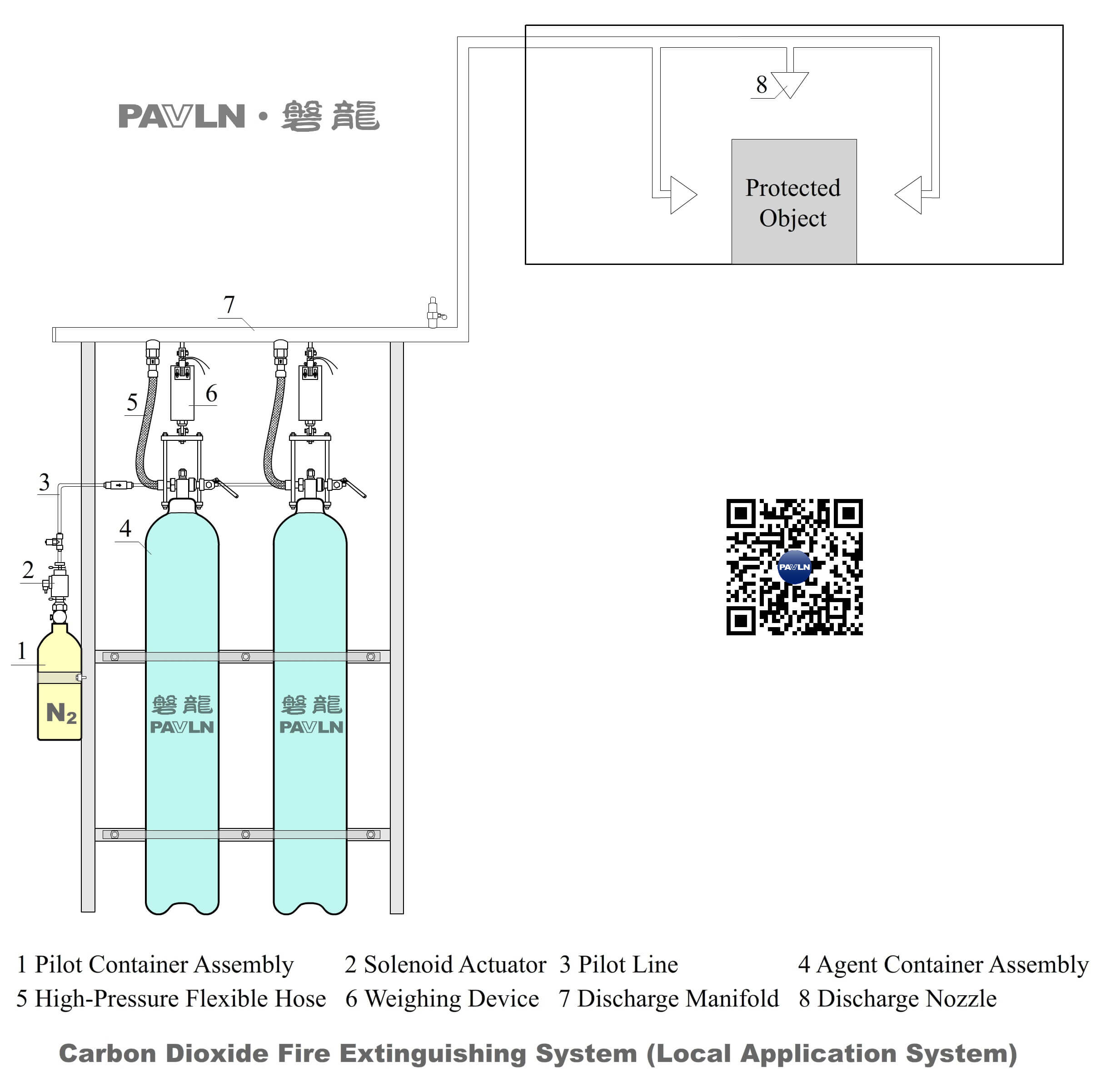
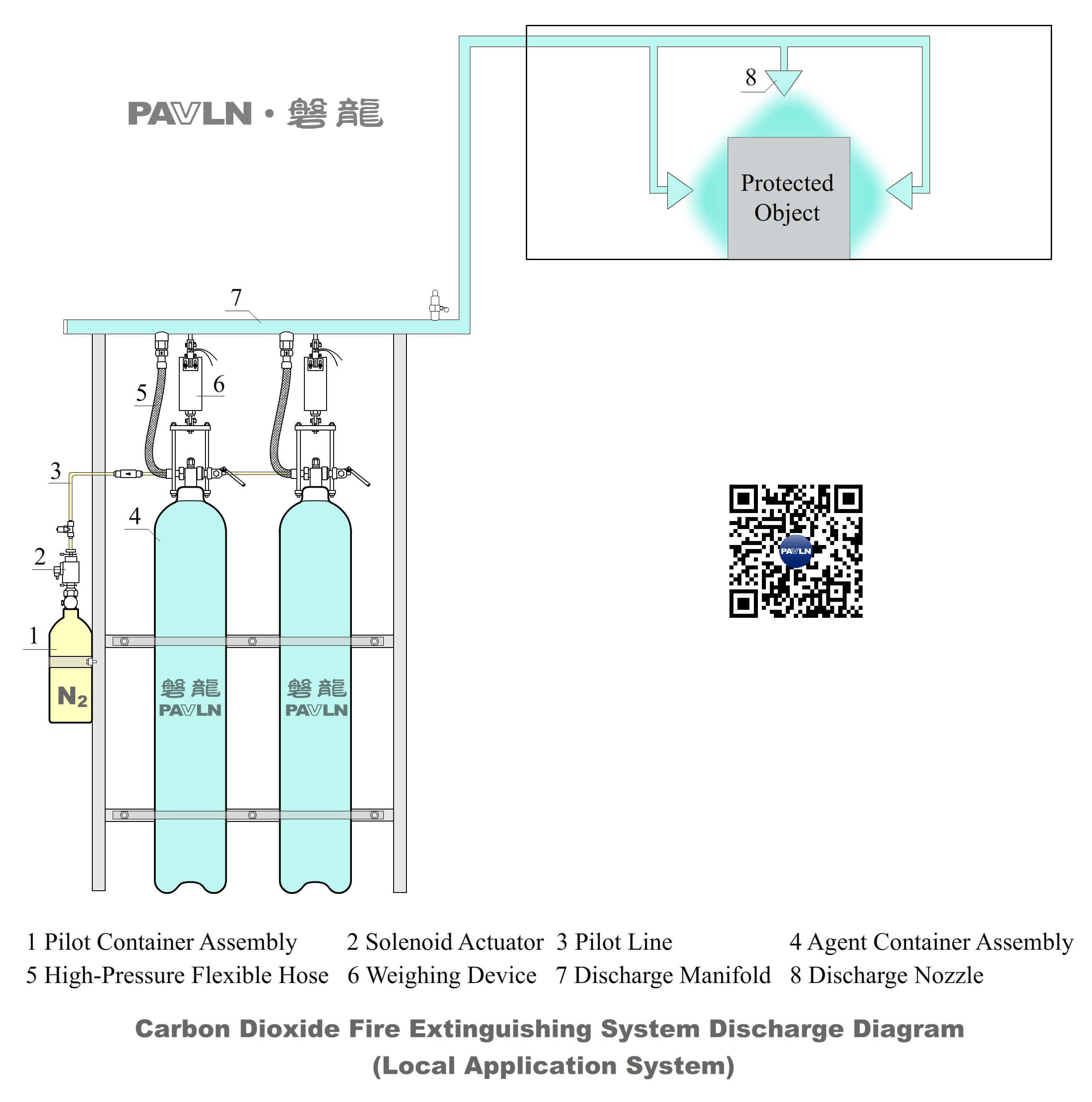
Local application systems are fire extinguishing systems that discharge extinguishing agent directly onto the protected object at the designed rate and continue for a specified period of time to achieve fire extinguishment. In engineering practice, local application systems are used relatively less frequently and are mainly used for objects protected locally by carbon dioxide fire extinguishing systems.
[Figure 8] and [Figure 9] use a carbon dioxide fire extinguishing system as an example to illustrate the arrangement and discharge condition of a local application system. When the system is discharged, the extinguishing agent covers only the specified protected object.
According to the pressurization and storage method, gas fire extinguishing systems can be divided into self-pressurized gas fire extinguishing systems, internal stored pressure gas fire extinguishing systems, and external stored pressure gas fire extinguishing systems.
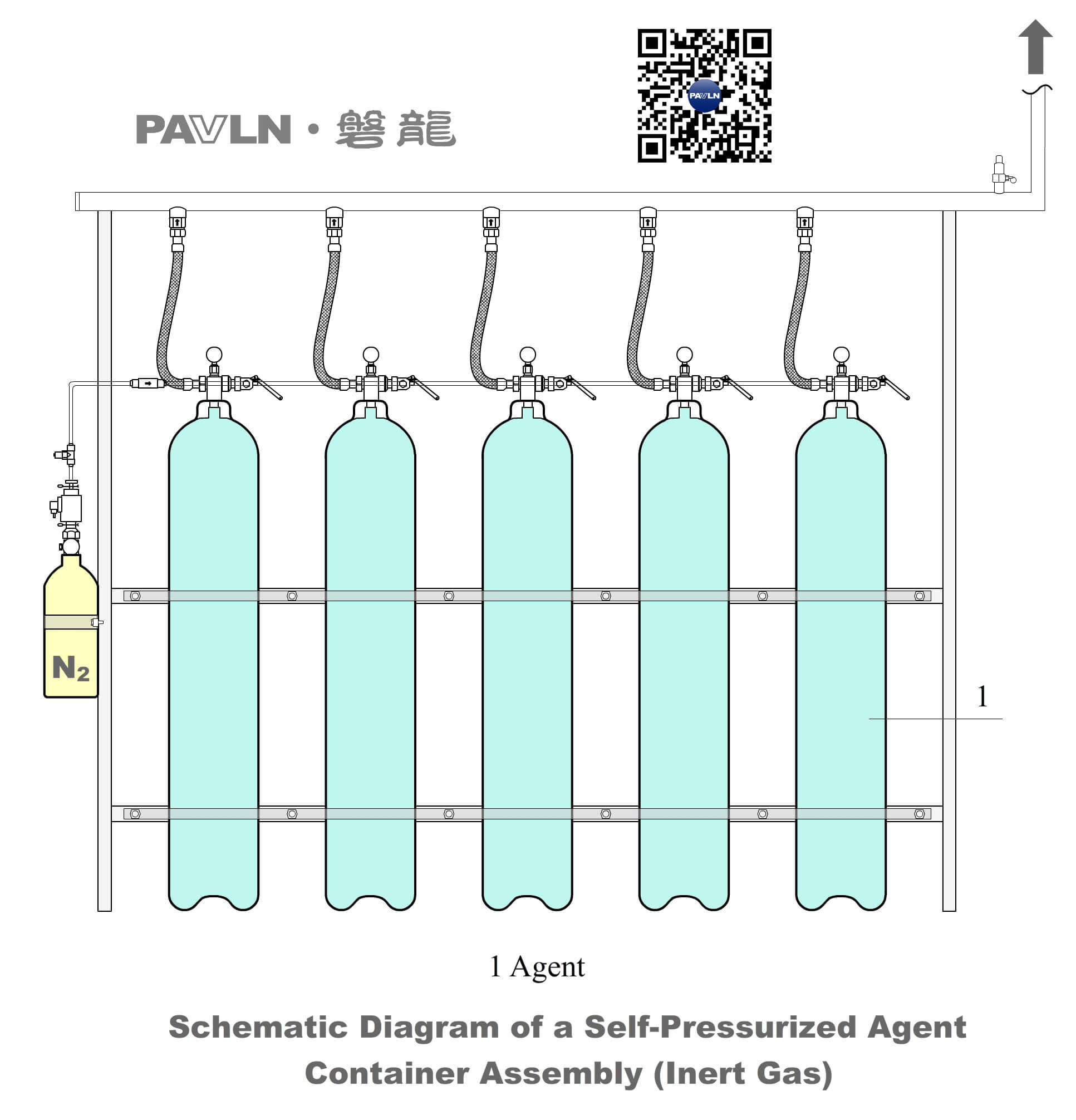
Self-pressurized gas fire extinguishing systems are systems in which the agent is discharged and conveyed by its own pressure. The following two types of agents are commonly used in self-pressurized gas fire extinguishing systems.
These agents do not liquefy within the service temperature range and are normally stored as high-pressure gases. The agent can be conveyed by its own pressure. Examples include inert gas agents such as IG-541, IG-100, IG-55, and IG-01 [Figure 10].
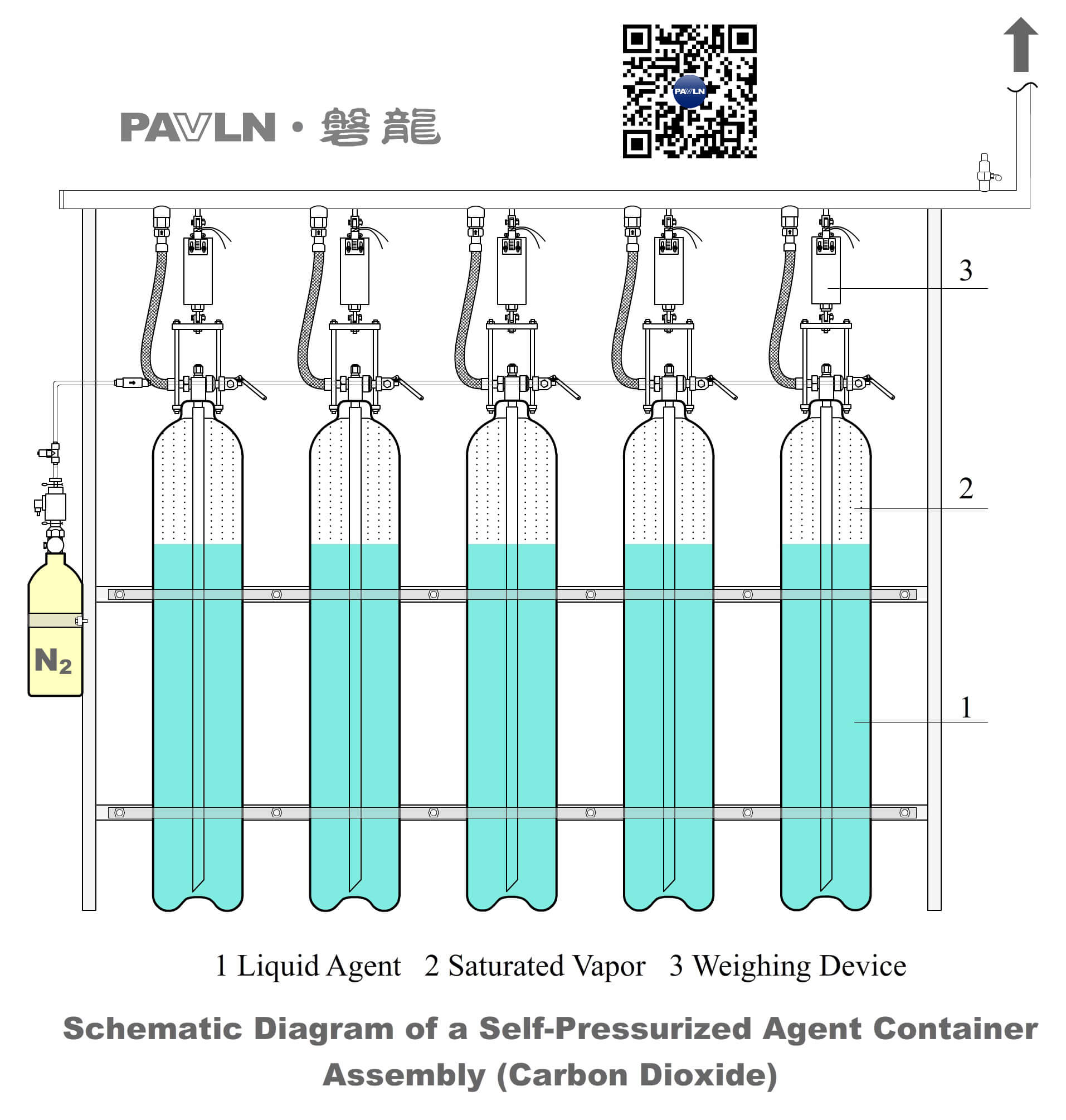
These agents may liquefy within the service temperature range, but even at the minimum service temperature, they can still be conveyed by their own pressure.
For example, carbon dioxide has a saturated vapor pressure of approximately 5.7 MPa at 20 °C, and it remains close to 3.5 MPa at the minimum working temperature of 0 °C. Therefore, it can be conveyed by its own pressure [Figure 11].
When the saturated vapor pressure of the agent is too low within the service temperature range for the agent to be conveyed by its own pressure, an inert gas, usually nitrogen, is required to pressurize the system and drive agent discharge.
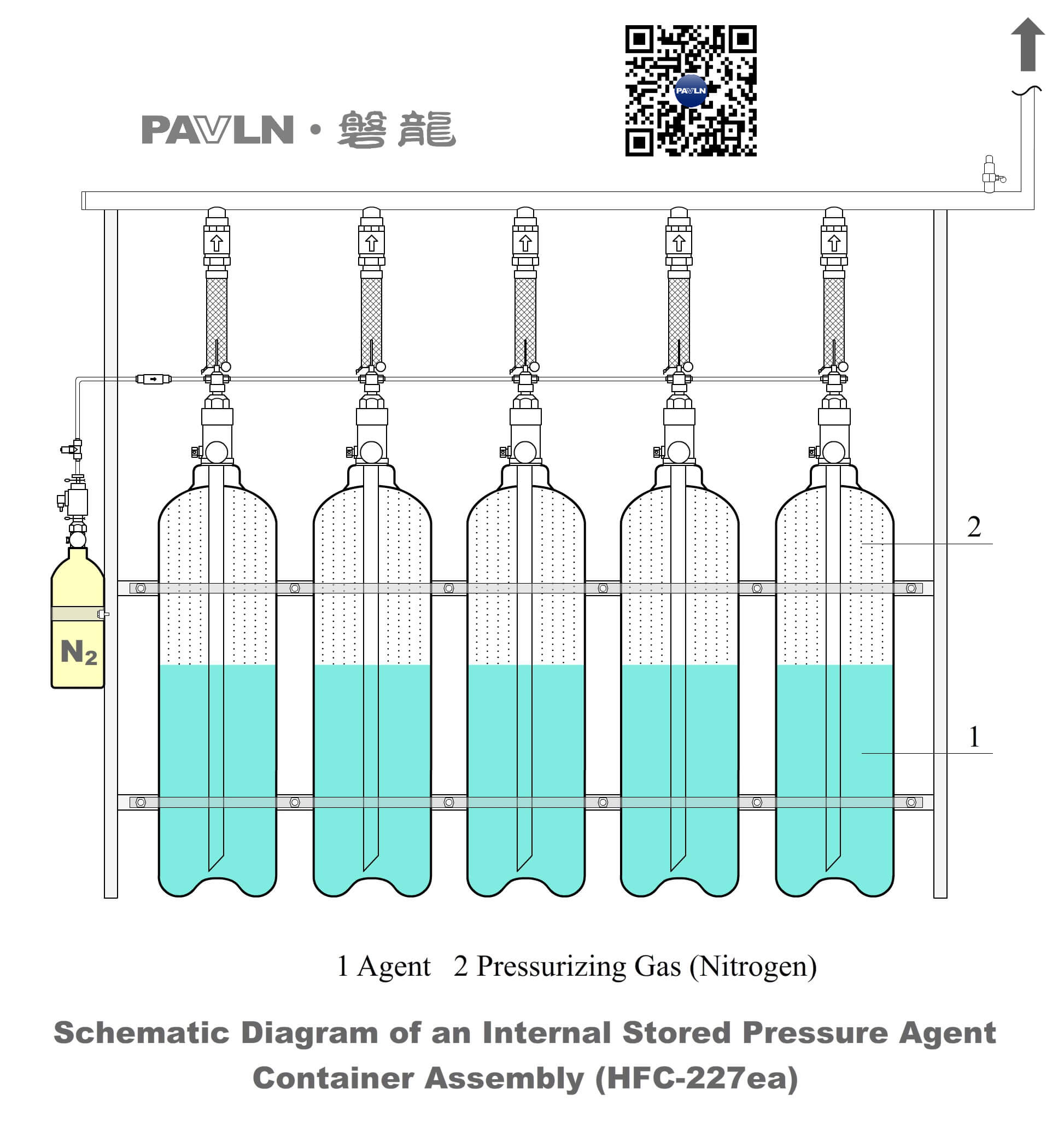
For example, HFC-227ea has a saturated vapor pressure of approximately 0.39 MPa at 20 °C. It normally requires nitrogen pressurization for effective discharge and is generally used in an internal stored pressure system, although an external stored pressure system may also be used.
Internal stored pressure gas fire extinguishing systems are systems in which the agent is driven and conveyed by pressurizing gas stored in the same container assembly. In this type of system, the agent and the pressurizing gas (nitrogen) are stored in the same container assembly [Figure 12].
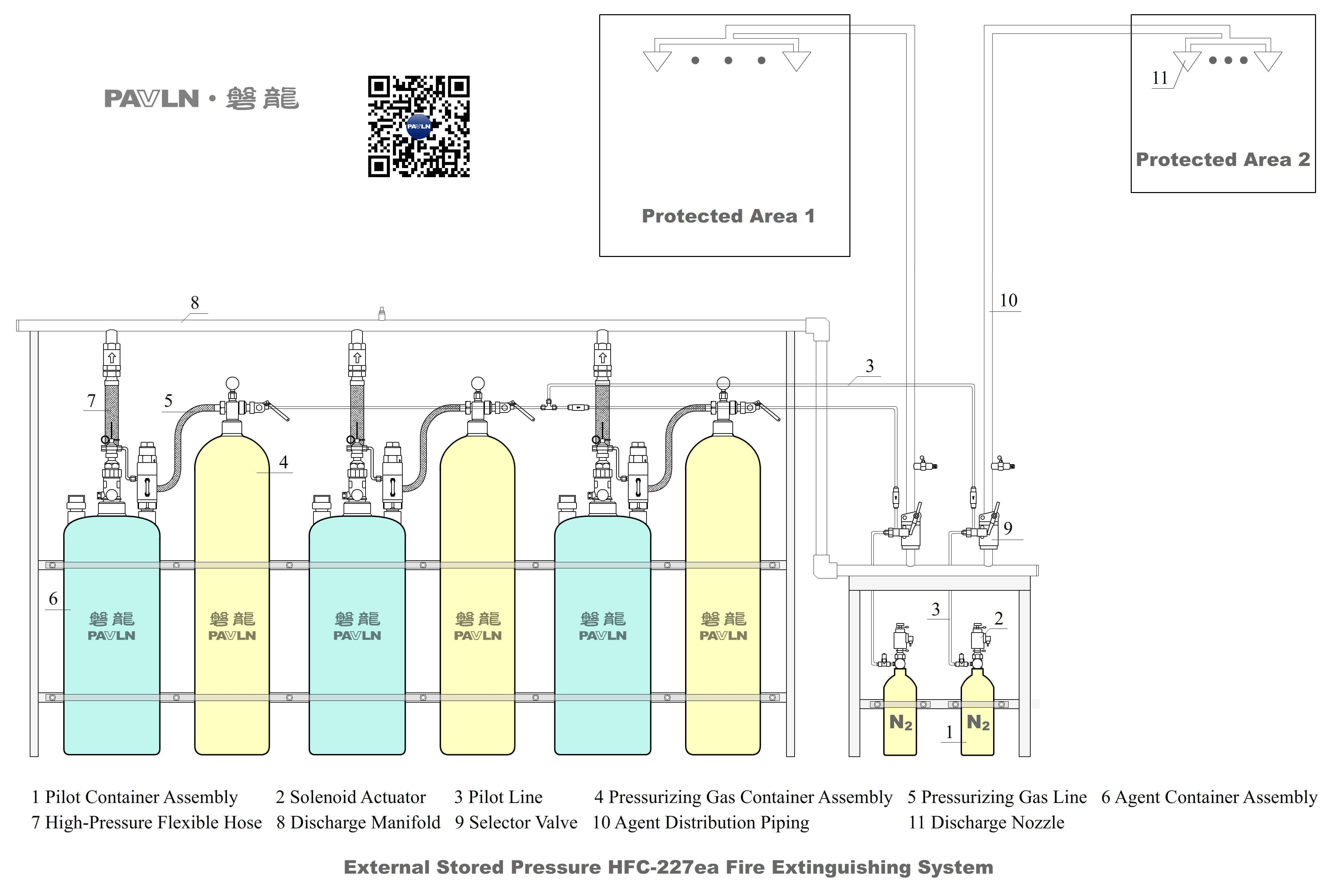
External stored pressure gas fire extinguishing systems are systems in which the pressurizing gas and the agent are stored separately in a pressurizing gas container assembly and an agent container assembly. When the system is actuated, high-pressure gas released from the pressurizing gas container assembly pressurizes the agent and drives it through the piping system.
Because the pressurizing gas is stored in an independent pressurizing gas container assembly, an external stored pressure system can usually achieve a longer agent discharge distance.
For example, HFC-227ea is generally used in an internal stored pressure system, but it may also be used in an external stored pressure system. In an external stored pressure HFC-227ea system, high-pressure nitrogen is stored in the pressurizing gas container assembly, while HFC-227ea is stored in the agent container assembly. When the system is actuated, high-pressure nitrogen from the pressurizing gas container assembly is released into the agent container assembly, driving the HFC-227ea agent to the protected area [Figure 13].
Typical applications of gas fire extinguishing systems include: