
1. Basic Concept

Fire Detection Tube Extinguishing Systems are automatic fire extinguishing systems that integrate fire detection and extinguishing actuation functions. The core component is the fire detection tube, which is typically installed inside protected equipment or near the location where a fire is most likely to occur.

Under normal conditions, the fire detection tube remains pressurized and sealed for monitoring. When the local temperature rises abnormally and reaches the operating threshold, the tube softens and ruptures at the point exposed to the highest heat. This causes a pressure drop inside the tube, generates a fire detection signal, and directly or indirectly initiates agent discharge.

According to the operating principle and the agent discharge method, fire detection tube extinguishing systems can be classified into direct-type fire detection tube extinguishing systems and indirect-type fire detection tube extinguishing systems.
2. Direct-Type Fire Detection Tube Extinguishing Systems

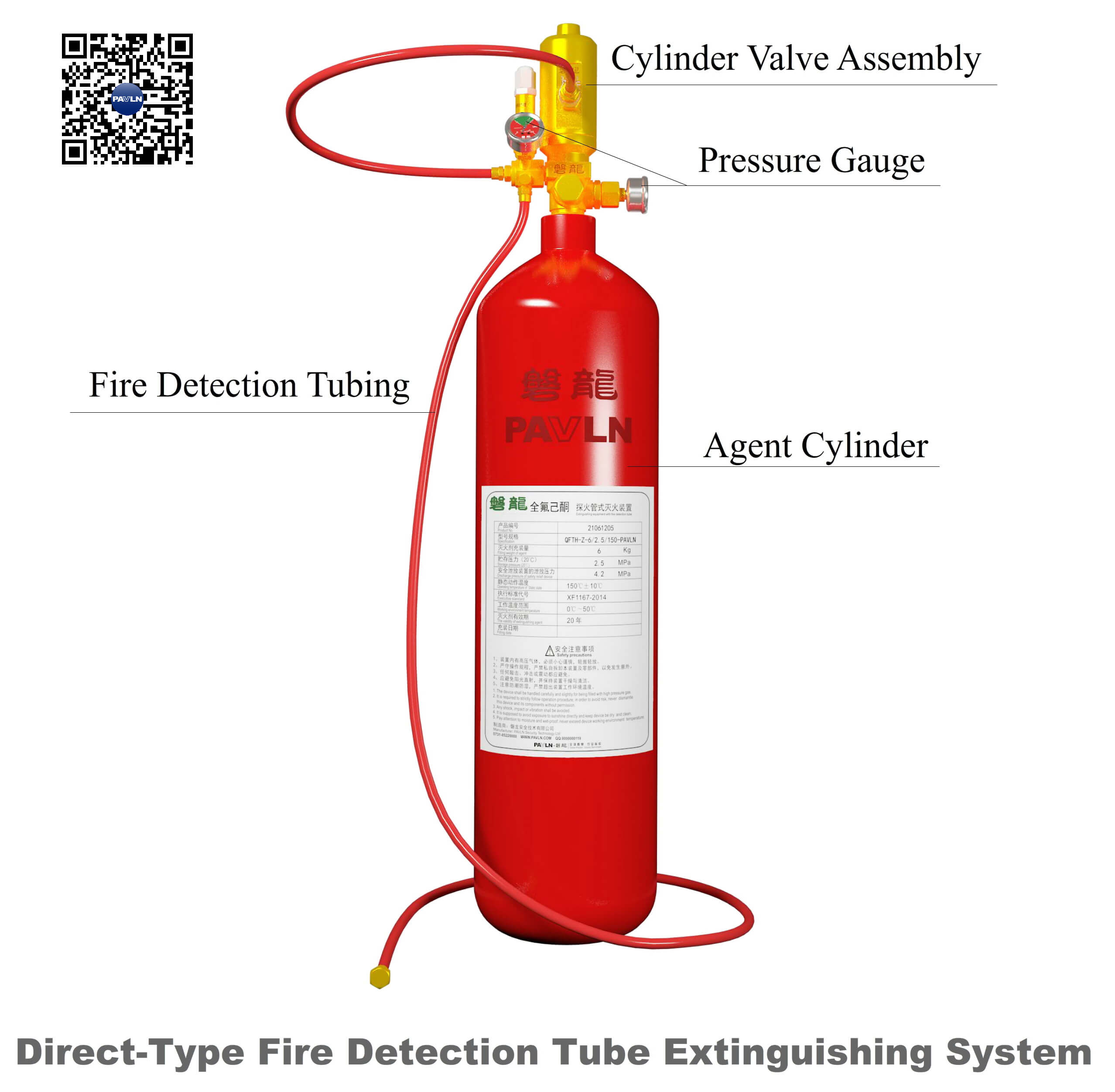
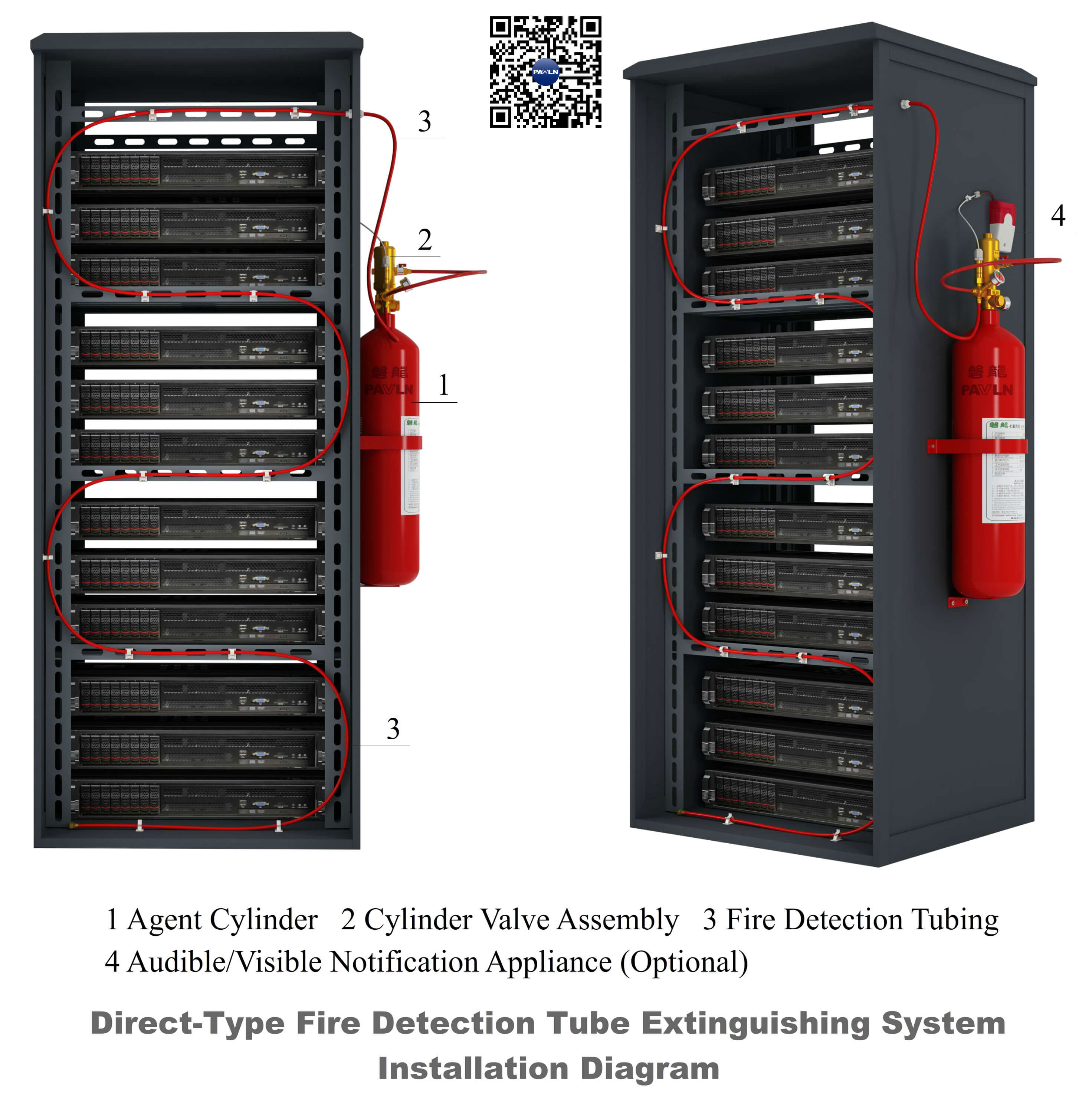
In a direct-type fire detection tube extinguishing system, the fire detection tube serves both as the fire detection element and as the agent discharge passage [Figure 1] [Figure 2].

In the event of a fire, the fire detection tube near the fire source softens and ruptures under heat exposure. The resulting pressure drop inside the tube actuates the container valve release mechanism, opening the container valve. The extinguishing agent is then discharged directly through the ruptured section of the tube and applied to the fire point or the adjacent area for fire extinguishment. See [Video 1].

Video 1. Discharge Sequence of the Direct-Type Fire Detection Tube Extinguishing System

This type of system features a simple structure, a short actuation path, and direct operation. It normally does not require complicated control circuitry and is suitable for rapid, localized extinguishment of incipient fires in small enclosures or within equipment.

3. Indirect-Type Fire Detection Tube Extinguishing Systems

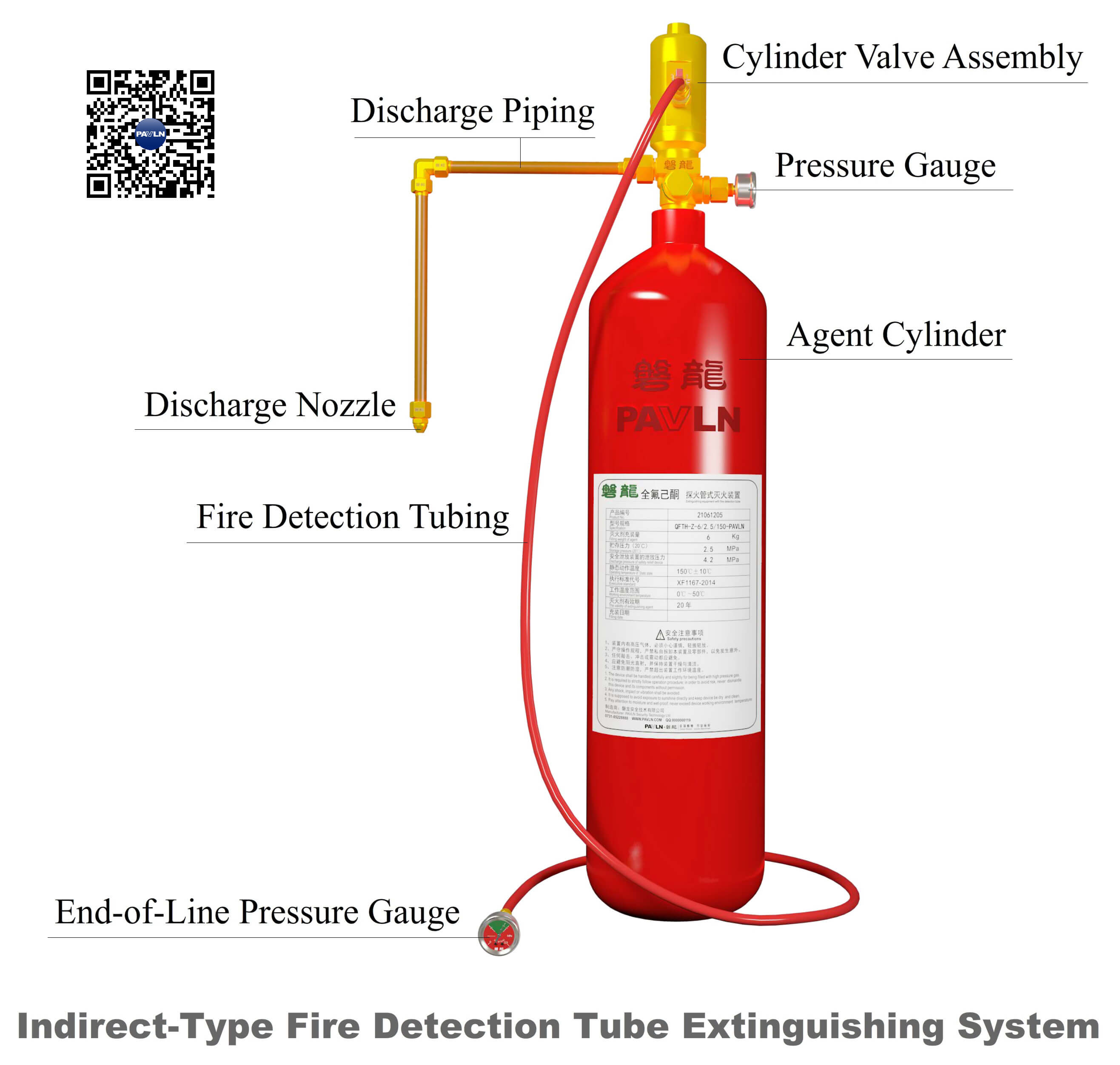
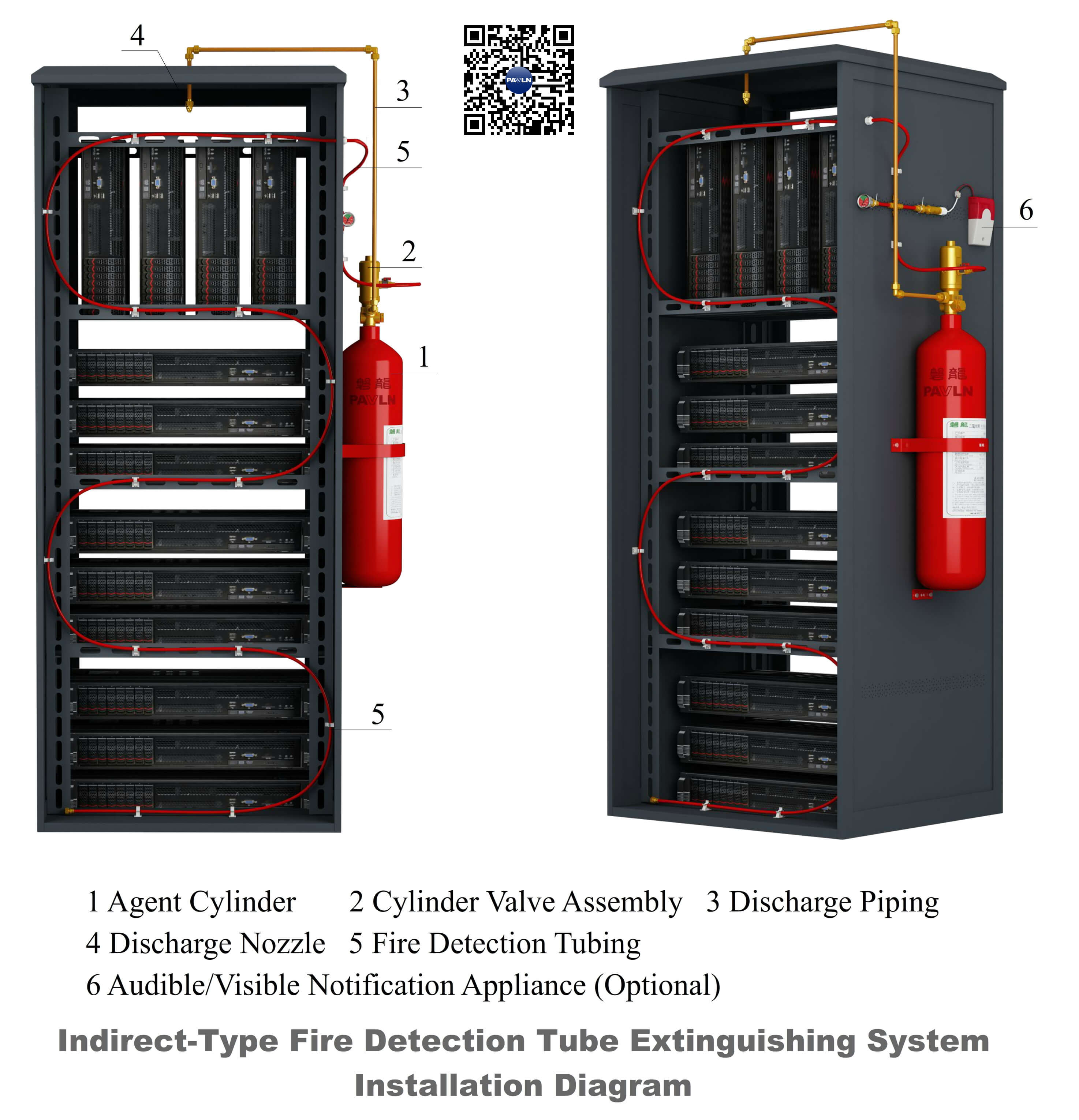
In an indirect-type fire detection tube extinguishing system, the fire detection tube is used only for fire detection and actuation and does not serve as the agent discharge passage [Figure 3] [Figure 4].

In the event of a fire, the fire detection tube ruptures under heat exposure, causing a pressure drop inside the tube. This actuates the container valve release mechanism and opens the container valve. The extinguishing agent is then discharged through dedicated piping and nozzles into the protected enclosure or onto the protected object. See [Video 2].

Video 2. Discharge Sequence of the Indirect-Type Fire Detection Tube Extinguishing System

Compared with the direct type, the indirect type separates the detection circuit from the discharge circuit, allowing more flexible agent distribution and better control of the discharge direction and coverage area. It is better suited to applications involving relatively larger spaces, more complex configurations, or specific discharge coverage requirements.

4. Extinguishing Agents

Different types of extinguishing agents may be selected for fire detection tube extinguishing systems based on the characteristics of the protected equipment or enclosure. Common extinguishing agents include the following:

Dry Chemical Agent

Dry chemical agents provide rapid fire extinguishment and are suitable for certain flammable liquid fires, flammable gas fires, and energized electrical equipment fires. However, they leave powder residue after discharge, which may cause contamination and makes them unsuitable for applications requiring a high level of cleanliness.

Clean Agent

Clean agents mainly include HFC-227ea and FK-5-1-12. They provide rapid fire extinguishment, leave no residue, are electrically nonconductive, and cause minimal contamination to equipment. They are widely used for power distribution equipment, electronic equipment, communication equipment, control cabinets, and other applications where a high level of cleanliness is required.

Carbon Dioxide Agent

Carbon dioxide provides a clean, electrically nonconductive extinguishing medium with no residue after discharge. It extinguishes fire primarily by reducing the oxygen concentration and is generally not suitable for protected spaces that are normally occupied.

5. Applications

Fire detection tube extinguishing systems feature a compact structure, convenient installation, direct response, and no need for an independent power supply or complicated control circuitry. They are suitable for applications involving relatively small, enclosed spaces, concentrated fire risks, and limited conditions for installing conventional fire extinguishing systems. Typical applications include:

• power distribution cabinets, control cabinets, and switchgear;

• telecommunication cabinets, network cabinets, and server cabinets;

• engine compartments, vehicle equipment compartments, and machinery compartments;

• localized enclosed spaces inside industrial equipment;

• battery boxes and energy storage equipment enclosures;

• other small localized spaces where conventional fire extinguishing systems are impractical but automatic fire protection is required.

6. Considerations

Fire detection tube extinguishing systems are mainly intended for protection inside relatively enclosed equipment. In most cases, they can extinguish only fires occurring inside the equipment and are generally ineffective against fires outside the equipment.

Therefore, fire detection tube extinguishing systems cannot replace automatic fire extinguishing systems required for a room or building. In engineering applications, they should be regarded as supplemental protection measures for specific equipment or localized fire risks, rather than as the sole fire protection measure for an entire room or protected space. In general, they may be used under the following conditions:

(1) The exterior of the equipment contains little or no combustible material, and the fire risk is mainly concentrated inside the equipment;

(2) The system is used as an enhanced protective measure for equipment, providing additional protection for critical internal parts on top of other existing fire protection measures.